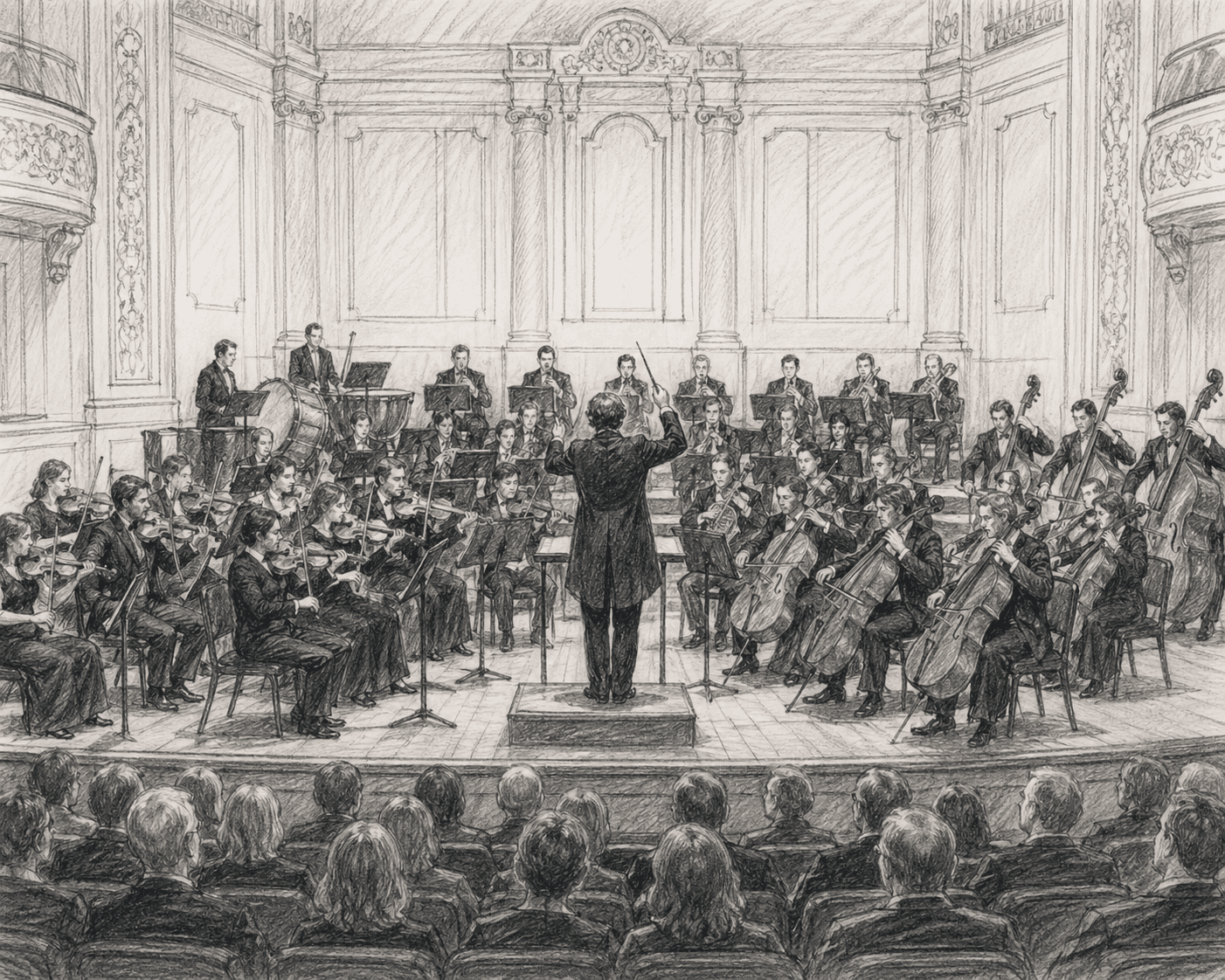
The orchestra is, at heart, a fan — strings nearest the conductor, winds and brass tiered behind, percussion at the rim.
The word orchestra is older than the thing it now describes. It once meant the half-circle of floor before a Greek stage, where the chorus moved and sang. Only by slow accretion did it come to mean the body of musicians that occupies that floor today — and that body, far from being one fixed institution, is in truth a small family of related ensembles, each shaped to a different repertoire.
A composer should know which orchestra is being written for before a single note is set on the page. The forces that suit Haydn will smother Mahler; the band that delivers Mahler will trample Haydn. Below, in brief, the principal kinds.
The symphony orchestra
The largest and most familiar of the orchestras — between eighty and a hundred and ten players, assembled to perform the standard repertoire from Beethoven onward. Its strings number some sixty; its winds and brass are present in pairs or threes; its percussion ranges as the score requires. The symphony orchestra is the instrument of the nineteenth century, and the twentieth never quite escaped it.
The chamber orchestra
A smaller body — twenty-five to forty players, with strings sometimes as few as four-three-three-two-one. It is the orchestra of Mozart and early Haydn, of Stravinsky’s neoclassical scores, of Britten and Adams in their leaner moods. Its character is conversational rather than oratorical. Each player is heard.
The string orchestra
The strings alone, without winds or brass — the ensemble of Tchaikovsky’s Serenade, of Elgar’s Introduction and Allegro, of Bartók’s Divertimento. Its forces are typically those of the chamber orchestra’s strings: a body homogeneous in colour, capable of astonishing range within that single timbre.
The Baroque orchestra
Smaller still, and built around a continuo — harpsichord or organ, with cello and bass. Strings are few; winds appear singly; brass and timpani, when present, are festal rather than structural. The Baroque orchestra is not a reduced symphony orchestra but a different instrument, with different tunings, different bows, and a different idea of what an ensemble is.
The opera orchestra
An orchestra of roughly symphonic forces, but seated in a pit and subordinate to the voice. It learns to play softer than seems possible, and to rise the moment the singer takes breath. Its Wagnerian extreme — the covered pit at Bayreuth — is among the most peculiar acoustic instruments ever devised.
“The orchestra is a great instrument capable of uttering at once or in succession a multitude of sounds of different kinds.”
— Hector Berlioz, Treatise on Instrumentation
Whichever kind one writes for, write for that kind. The orchestra is not a generic pool of timbre; it is a particular assembly, with particular habits, on a particular stage.
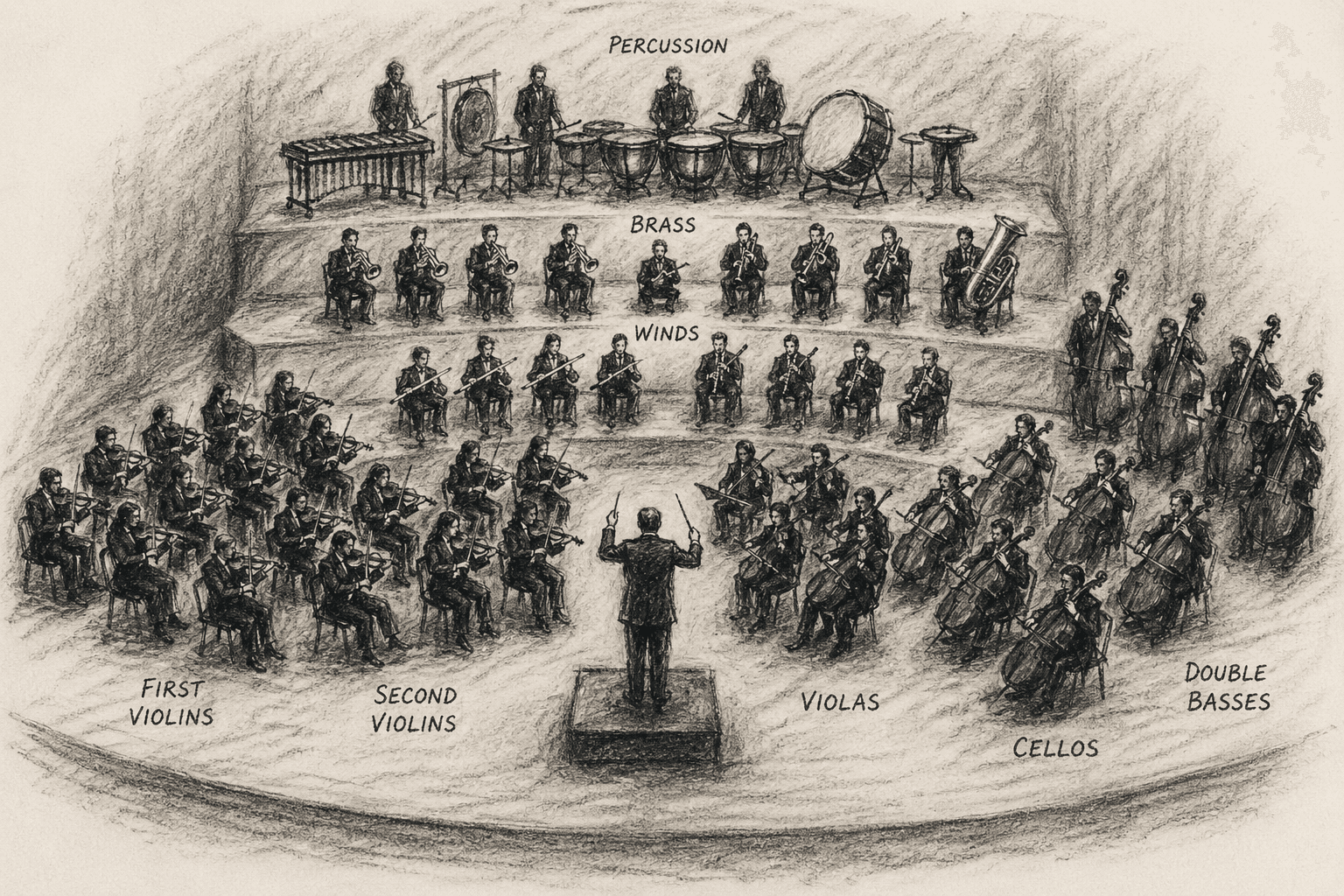
The American seating — both violin sections to the conductor’s left, cellos and basses to the right.
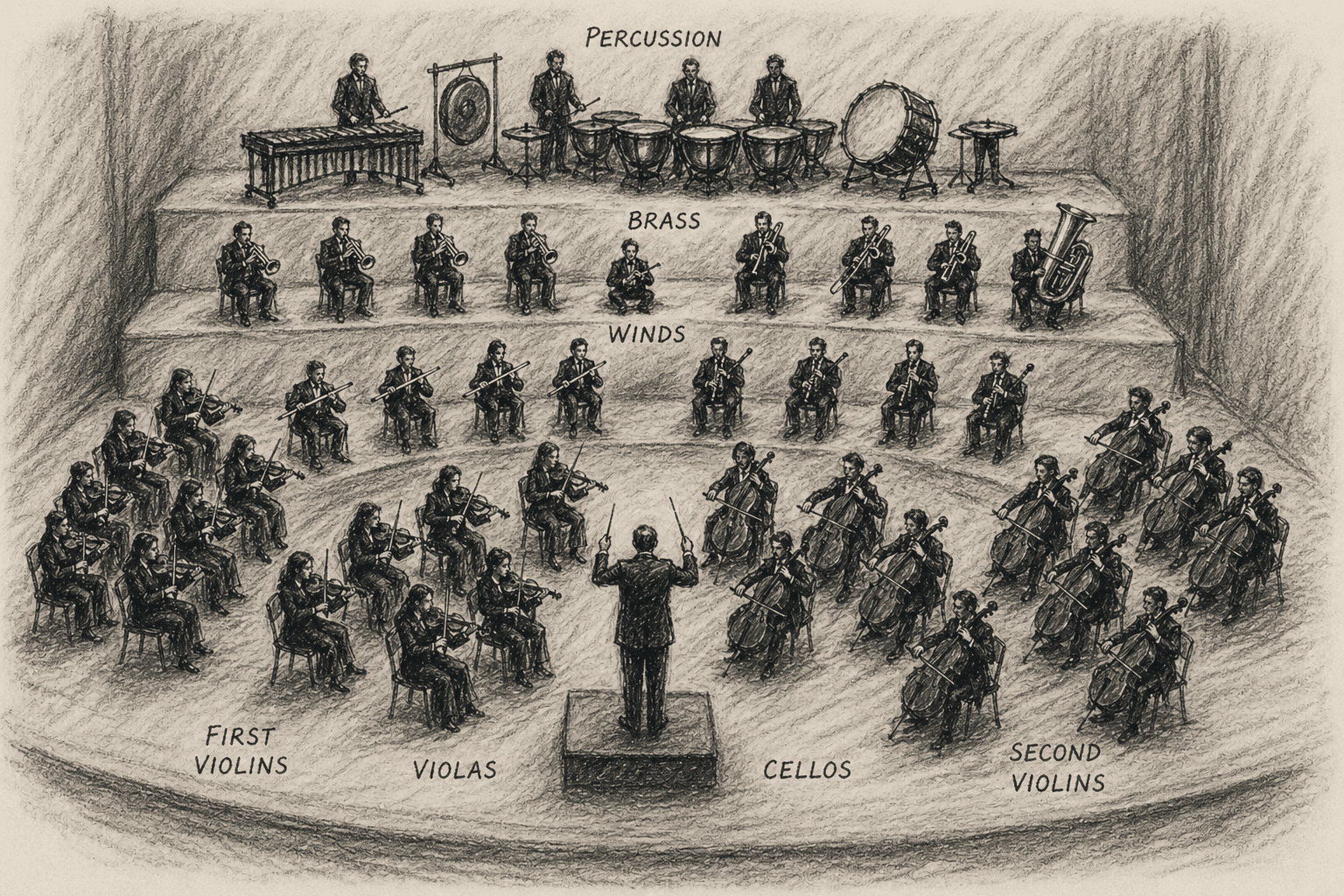
The German, or antiphonal, seating — first and second violins facing one another across the stage, with violas and cellos between.
How the orchestra is arranged upon the stage is no idle question. The seating decides what blends and what cuts through, what the conductor hears, what the audience hears, and — to a degree composers seldom reckon with — how the music itself is read by the players. There is no single arrangement. There are conventions, and within them, considered choices.
The American seating
The arrangement now standard in most of the world: first violins to the conductor’s left, second violins beside them, then violas, then cellos to the right; double basses ranged behind the cellos. Winds and brass tier upward in rows behind the strings, percussion at the back. Adopted by Stokowski in Philadelphia in the 1920s and championed thereafter, it favours blend in the upper strings — both violin sections face the audience — and a unified, forward-thrown sound.
The German, or antiphonal, seating
The older arrangement, restored in recent decades by conductors of a historical bent: first violins to the left, second violins to the right, with violas and cellos between. The two violin sections face one another across the stage. Music written before the First World War — and a great deal written after it — was conceived for this layout. The antiphonal exchanges in Mozart, in Brahms, in Mahler are intelligible in a way they cannot be when the seconds are absorbed into the firsts.
Variants and dispositions
Within these two main schemes, every orchestra carries its small habits. Some place the cellos to the conductor’s right, some to the left of centre. Basses may rise behind the cellos, or stretch along the back of the strings, or stand in a single line at the rear. Winds sit in two rows — flutes and oboes in front, clarinets and bassoons behind, or the reverse — depending on the hall and the conductor’s preference.
Brass tier behind the winds: horns to one side (commonly the left), trumpets and trombones opposite, tuba at the end of the row. Timpani sit at the back, often raised; the rest of the percussion ranges beside them. Harps, when present, take a place at the side of the first violins, where the conductor can see them and the strings can hear them.
What the seating does to the score
A composer ignorant of the seating writes blindly. A passage tossed between first and second violins reads as a single voice in the American layout and as a stereo dialogue in the German. Horns answering trumpets across the stage are theatre; horns answering trumpets from a metre apart are merely orchestration. Know which orchestra will play your music, and where its players will sit. If you do not know, ask.
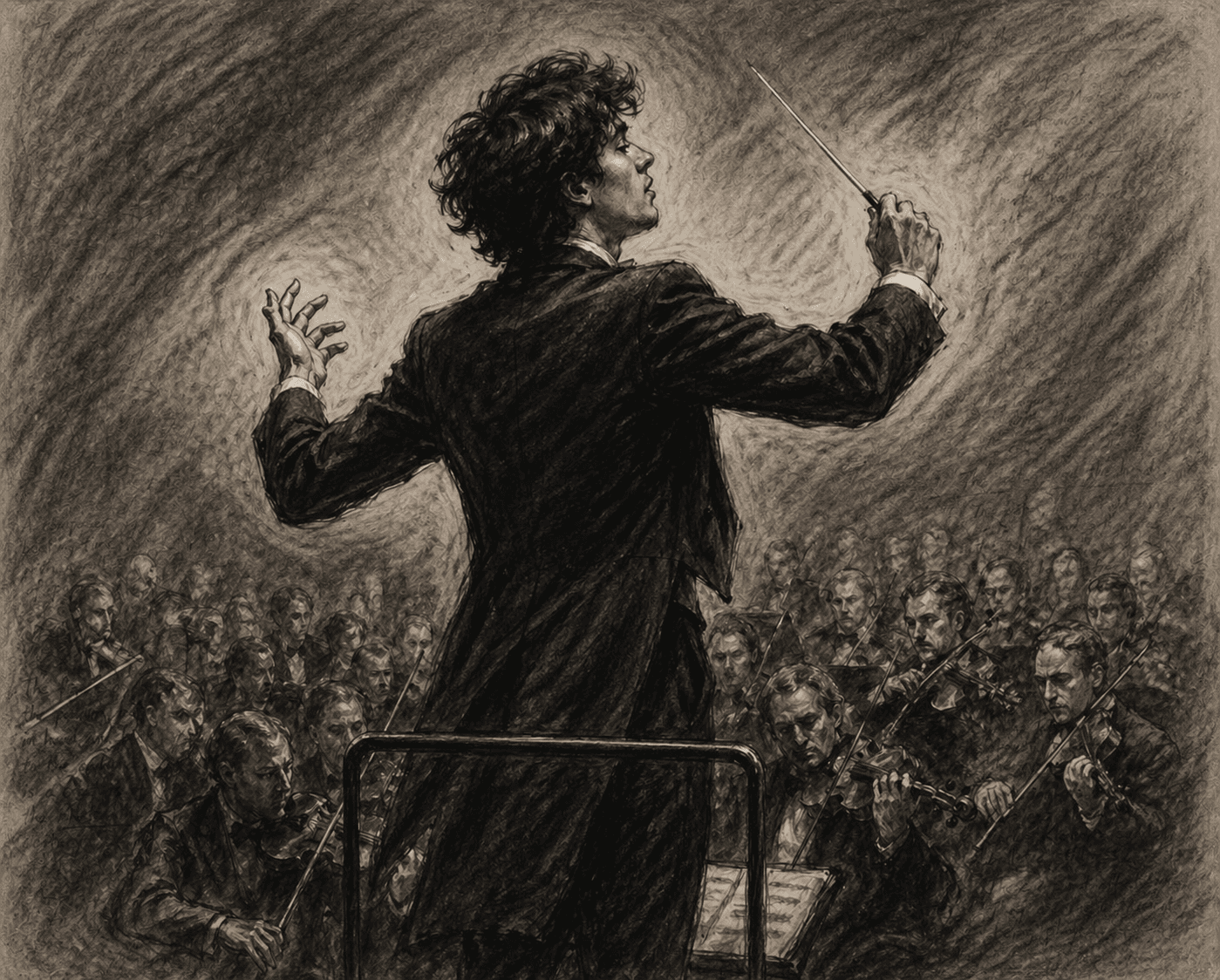
The conductor — bâton in the right hand, the left hand free for everything the score does not say.
The conductor is the orchestra’s newest instrument — younger than the bassoon, younger than the clarinet, younger by far than the orchestra itself. For most of its history the orchestra led itself: a keyboardist from the continuo, a violinist from the first desk, a composer beating time with a roll of paper. The figure on the podium, bâton in hand and back to the audience, is a creature of the nineteenth century.
What the conductor does
The conductor’s task is, at its most prosaic, to keep the players together — to set the tempo, mark its changes, and indicate entrances. This is the smaller half of the work. The larger half is interpretive: the shaping of phrase, the calibration of balance, the weighting of dynamics, the choice of how a long musical thought should breathe. A great conductor adjusts a hundred details that the score leaves unwritten, and persuades the players to adjust with them.
The bâton, and the hands
The bâton, held in the right hand, beats time and articulates the pulse. The left hand — free, expressive, and idiosyncratic — does nearly everything else: cuing entrances, shaping crescendi, hushing the brass, drawing the cellos forward. The greatest conductors have always been those whose left hand seemed almost to compose in the moment. Furtwängler’s tremor, Karajan’s closed eyes, Carlos Kleiber’s sudden, balletic stillness — these are not affectations. They are the instrument being played.
Rehearsal, and what is decided there
A concert performance is the visible part of a much longer iceberg. The work of the conductor is largely done in rehearsal: balances adjusted, phrasing argued, doublings reweighted, transitions made to sit. By the night of the concert, ninety per cent of what an audience will hear has been settled; what remains is the small, irreducible margin in which something extraordinary may, on a good evening, happen.
A note for the composer
Write for the orchestra, not for the conductor. A score whose balances are honest, whose tempi are reasonable, whose entrances are clear, will be welcome on any podium. A score that depends on a conductor of genius to make it cohere has, by that very dependence, already failed.
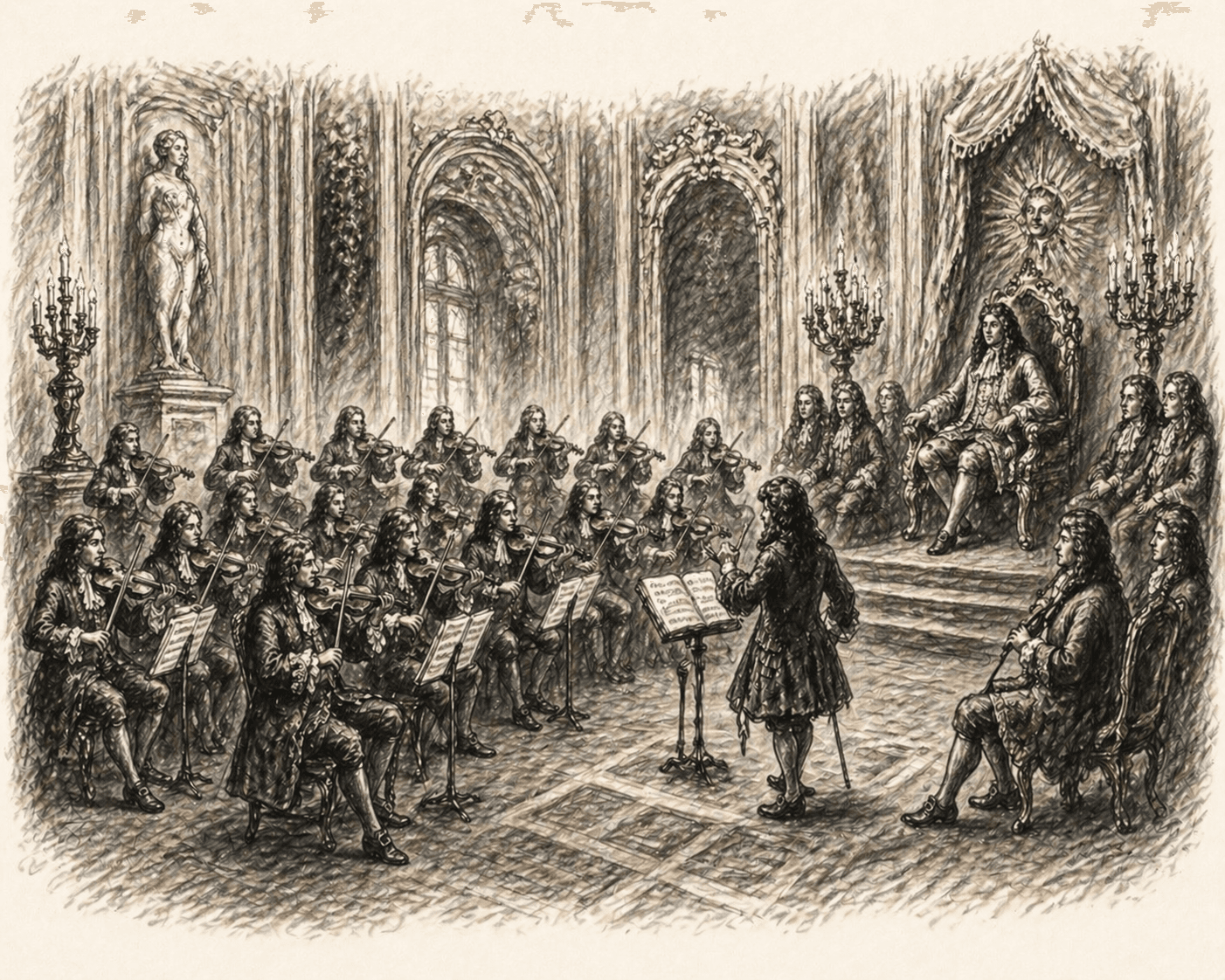
Lully and the Vingt-quatre Violons du Roy at the court of Louis XIV — perhaps the first ensemble recognisable as a true orchestra.
The orchestra was not invented. It accumulated. Across some four centuries — from the courts of late-Renaissance Italy to the concert halls of the present — the loose ensembles of strings, winds, and continuo gradually settled into the standardised body we now take for granted. The history is one of consolidation, not revolution.
The seventeenth century: a body forming
At the court of Louis XIV, Lully’s Vingt-quatre Violons du Roy— twenty-four string players in five parts — was perhaps the first ensemble recognisable as a true orchestra: standardised, salaried, rehearsed. Italian opera houses of the same period maintained comparable forces, with strings around a continuo and a few obbligato winds. The defining trait was not size but discipline.
The eighteenth century: the classical orchestra
By Haydn’s middle years the orchestra had taken the shape that Mozart, Beethoven, and Schubert would inherit: strings in five parts; pairs of flutes, oboes, clarinets, and bassoons; pairs of horns and trumpets; timpani. The continuo faded, and with it the keyboardist who had directed from it. The first violinist began to lead from his desk, bow raised; the seed of the modern conductor was planted there.
The nineteenth century: expansion
Beethoven’s Ninth, with its trombones and contrabassoon and piccolo, was the first symphony for which the classical orchestra was plainly too small. From there the body grew steadily — Berlioz dreaming of four hundred and sixty-seven players in his Treatise, Wagner adding bass trumpet and contrabass tuba and a quartet of Wagner tubas, Mahler drawing the orchestra to its outermost plausible shape. By 1900 the symphony orchestra had reached, in essence, the size and constitution it has today.
The twentieth century: divergence
The twentieth century, having inherited a maximum, did two things at once: it pressed further outward — Schoenberg’s Gurre-Lieder, Strauss’s Alpensinfonie, the gigantism of late Mahler — and it withdrew sharply inward, into the chamber forces of Stravinsky’s L’histoire du soldat, of Webern, of Boulez. The orchestra ceased to be a single thing and became a spectrum, from solo ensemble to assembled multitude, with the symphonic mid-point still the convention but no longer the rule.
The present
The orchestra today is a settled instrument played by a restless culture. Its forces have not meaningfully changed in a century; its repertoire is, by historical standards, frozen; its institutions are among the oldest continuously functioning in Western public life. That very stability is what makes it, for the composer, both a privilege and a problem. The orchestra you write for now is the one that played for Brahms. Write accordingly.