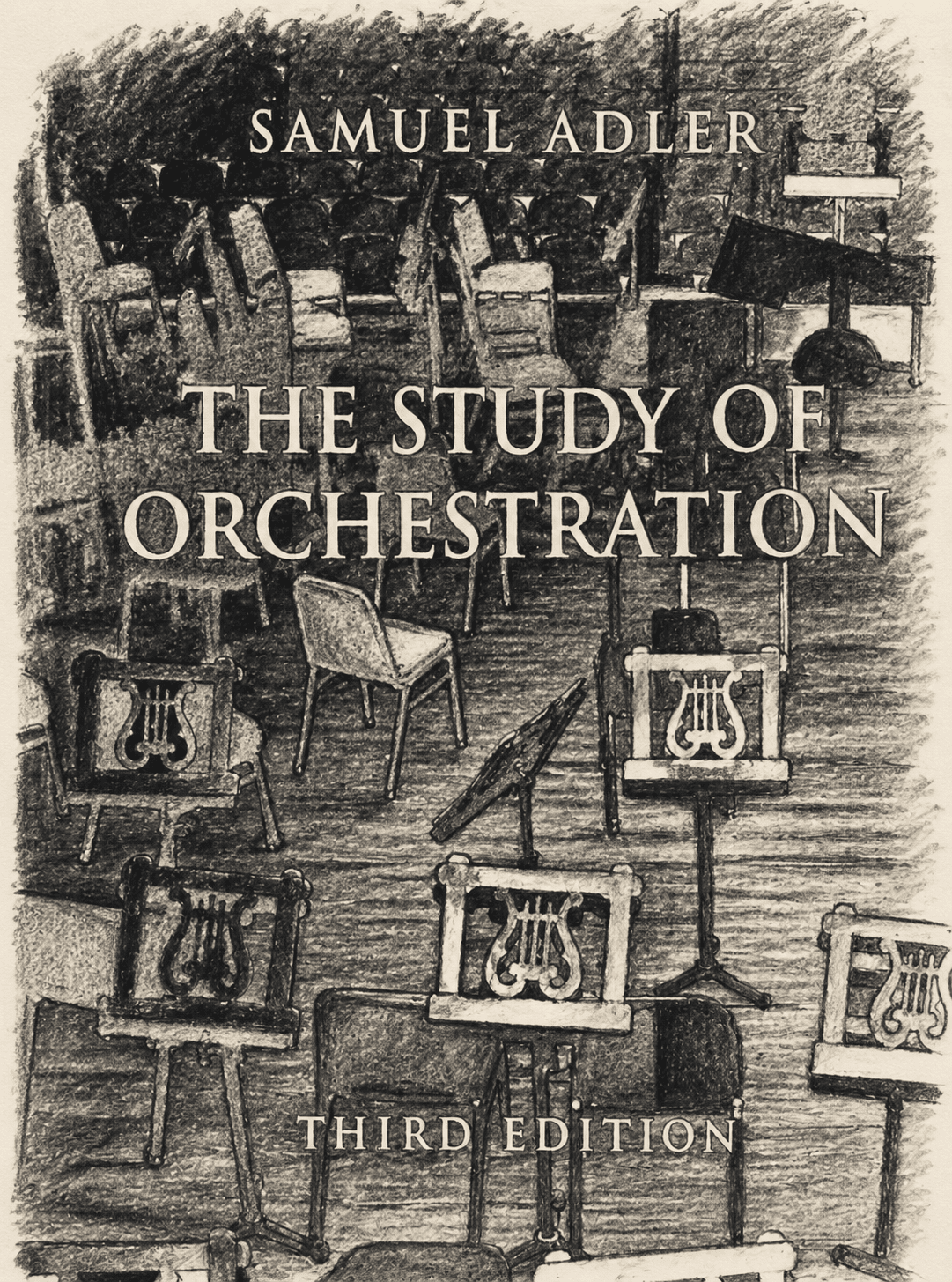
Samuel Adler, The Study of Orchestration — the standard textbook of the conservatories, and a fair portrait of the literature as a whole: the chairs are set, the stands wait, the players have not yet come in.
The literature on orchestration is, by the standards of any modern discipline, small. Half a dozen treatises form its spine; a further dozen or so books — practical, historical, idiosyncratic — hang usefully from it. A composer who has read them all is rare. A composer who has read none of them is, regrettably, common.
The standard treatises
Hector Berlioz — Grand traité d’instrumentation et d’orchestration modernes (1844, revised by Strauss 1904). The founding text. Berlioz writes as a composer, not a theorist; the prose is opinionated, lyrical, and frequently wrong on points of fact. It remains, after nearly two centuries, the most readable book ever written on the orchestra.
Nikolai Rimsky-Korsakov — Principles of Orchestration (posthumous, 1913). The most systematic of the classic treatises. Drawn entirely from his own scores, with examples printed in full. Indispensable for the student; quietly authoritative for the practitioner.
Charles-Marie Widor — Technique de l’orchestre moderne (1904). A careful supplement to Berlioz, written when many of the instruments Berlioz knew had already changed. Particularly good on the late-Romantic woodwinds and the Wagnerian brass.
The twentieth-century books
Walter Piston — Orchestration (1955). The American textbook, dry, accurate, and exhaustive. A composer who absorbs Piston will write a competent score. A composer who absorbs only Piston will not write a memorable one.
Samuel Adler — The Study of Orchestration (1982; now in its fourth edition). The current standard in conservatories, with recorded examples and a vast quantity of repertoire excerpts. Adler is patient and thorough, and his ear is excellent.
Kent Kennan and Donald Grantham — The Technique of Orchestration (1952; sixth edition 2002). Less encyclopaedic than Adler, more focused on the act of writing. Useful as a second opinion when Adler is silent.
On the instruments themselves
Anthony Baines — Woodwind Instruments and Their History (1957). Still the best general history of the woodwinds. Baines was a player and a curator, and the book carries the authority of both.
Philip Bate — The Trumpet and Trombone (1966) and The Oboe (1956). Older, but compact and honest. Indispensable for anyone writing for brass with historical sensitivity.
David Boyden — The History of Violin Playing from its Origins to 1761 (1965). Not a book on orchestration, but the deepest single volume on what the strings actually were when the orchestra was being formed.
The strange and the singular
Cecil Forsyth — Orchestration (1914). A book of opinions by an English composer of the second rank, written in prose of the first. Read for its judgements, not its rules.
Gardner Read — Thesaurus of Orchestral Devices (1953). A catalogue, not a treatise. When you need to know whether something has been tried before, and by whom, Read is where you look.
Norman Del Mar — Anatomy of the Orchestra (1981). The conductor’s view of the instrument. Witty, observant, and full of the practical knowledge that treatises tend to omit.
“One reads Berlioz to fall in love with the orchestra, Rimsky-Korsakov to learn its grammar, and Adler to keep one’s self honest.”
— common counsel
What was once a private library of scores, recordings, and interviews is now, in large part, a few clicks away.
Most of what a composer needed in 1950 — a wall of scores, a record collection, a friend at the orchestra — is now, in some form, online. Not all of it is good, and a great deal of what is good is buried beneath what is not. The list below is a small attempt at curation.
Scores and parts
IMSLP — the International Music Score Library Project. The single most important resource on this list. Almost every score out of copyright is here, often in multiple editions. Begin every study session by checking what IMSLP holds.
The Petrucci Library (the public face of IMSLP) and the digitised holdings of the major national libraries — the BnF Gallica, the British Library, the Library of Congress, the Bavarian State Library — between them cover the manuscripts and first editions that IMSLP does not.
Recordings, with score
YouTube channels of the major orchestras. The Berlin Philharmonic, Concertgebouw, Vienna, LSO, and the American majors all maintain channels with rehearsal footage, masterclasses, and performances. The Berlin Philharmonic’s Digital Concert Hall is paid, but the standard of filming and audio is unique.
“Score-along” channels. A small number of devoted amateurs have, over the past decade, synchronised hundreds of recordings to scrolling scores on YouTube. Quality varies; the better channels are an extraordinary gift.
On the instruments
The Vienna Symphonic Library — Academy. Built as documentation for a sample library, the VSL Academy is, by accident, one of the better online references on the orchestral instruments: ranges, articulations, colours, and recorded examples.
Player channels. A growing number of orchestral players — first chairs especially — keep YouTube channels addressing the questions composers actually ask: what is comfortable, what is possible, what is merely hard. Search for the principal of the instrument you are writing for; you will be surprised how much is there.
Orchestration Online
Thomas Goss — Orchestration Online. A composer and orchestrator who has spent the better part of two decades building, almost single-handedly, the most useful teaching resource on orchestration on the open internet. There is a website — tutorials, courses, reviews, eBooks — and a long-running YouTube channel whose patient, unshowy videos on score-reading, instrumentation, and the daily craft of writing for orchestra are without real rival. Around it has grown a community of some forty thousand composers across YouTube, Patreon, and the social platforms — the nearest thing the discipline has to a public square.
Reference and reading
Grove Music Online (subscription, often through a library). The standard reference work in English; the entries on instruments and on individual orchestras remain authoritative.
OrchestraLibrarian.com, the OSTI archives, and the various forums for orchestral librarians. Practical knowledge of how parts are actually prepared, marked, and corrected — a literature that exists almost nowhere in print.
A caution
The internet is a magnificent library and a poor teacher. It will answer almost any question one thinks to ask, and almost no question one has not yet learnt to. The treatises listed under Books exist, in part, to teach a composer which questions to ask; the resources here exist to answer them. Use them in that order.