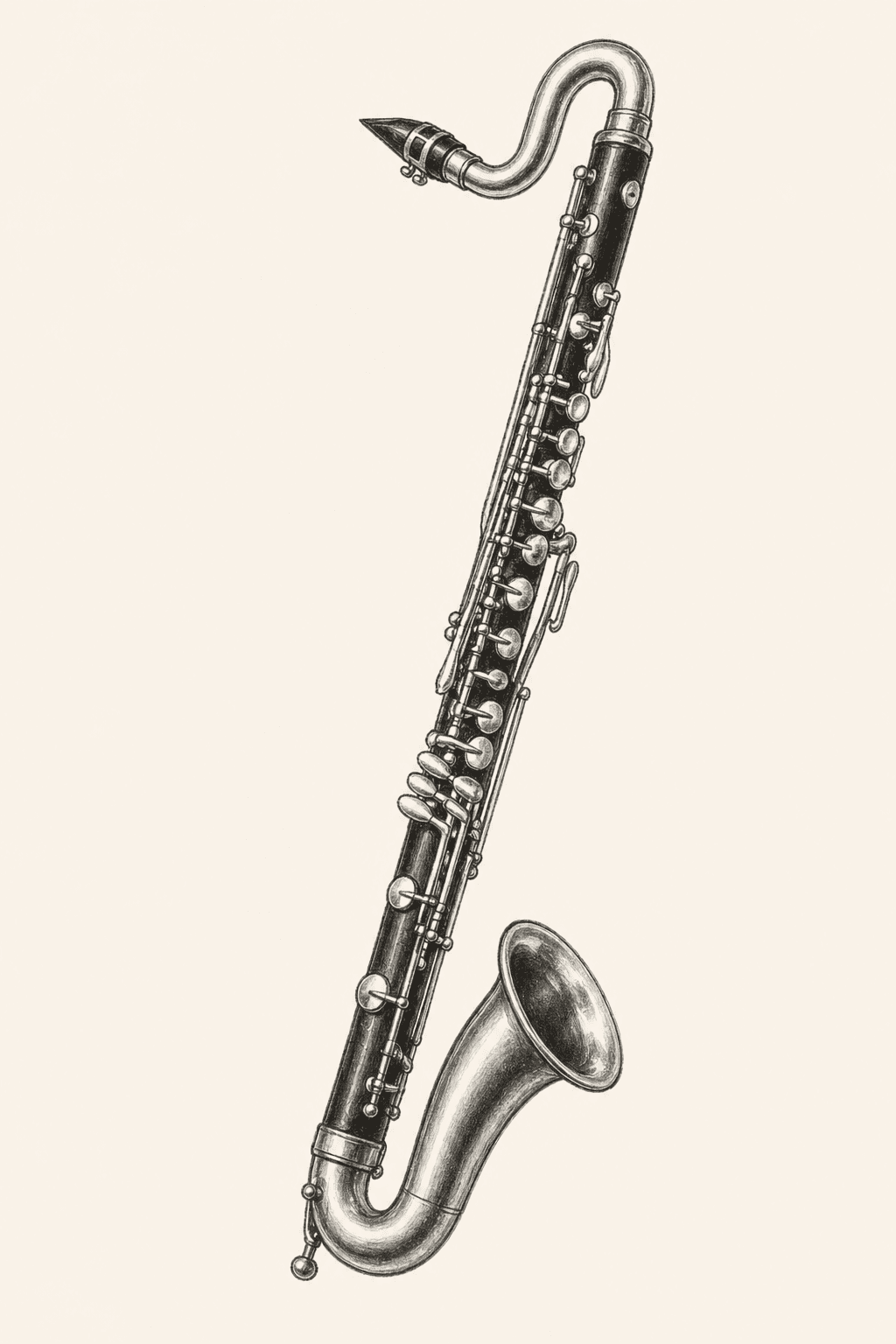
A cylindrical column of grenadilla, a curved metal neck above and an upturned bell below — the clarinet, lengthened until it can almost growl.
The bass clarinet is the orchestra’s great confider. Its bore — a slender cylinder a metre long, with a metal neck curved upward to the mouthpiece and a flared bell turned upward to the hall — gives it a sound that is dark without being heavy, and present without ever pressing forward. It can disappear into a cello line, or hold the room in a single low note for as long as breath allows.
It is a transposing instrument in B♭, sounding a major ninth below the written page — and it is, in modern hands, almost always notated in the treble clef of its smaller cousin. The fingerings are the soprano clarinet’s. The voice, however, is not. Where the soprano is bright and forward, the bass clarinet is inward and slow, and asks of the composer a different patience.
Mechanism
Like its smaller relative, the bass clarinet is a cylindrical bore of grenadilla closed at the mouthpiece end by a single reed bound to a beak. The length is roughly twice that of the soprano, which would put the mouthpiece beyond the player’s reach were it not for the curved metal neck at the top. The bore terminates not in an open cone, as on the soprano, but in an upturned metal bell, much like a saxophone’s. The instrument is supported by a peg or floor spike, or a neck strap, depending on player and tradition.
Two extensions to the lowest notes are common. Older instruments stop at written E♭₃, matching the soprano. Modern professional models extend down through written D₃ to a low C₃ — sounding B♭₁, the same pitch as the bottom of the bassoon. A composer writing for a major orchestra in the present day may safely assume the longer instrument; for studio and student work, ask first.
Voice and Character
Berlioz, in his Treatise, called the bass clarinet a tone of “menacing solemnity, admirable in the lower notes.” He understood the instrument’s peculiar gift: that it can carry weight without volume. A pianissimo low C — sounding deep below the staff — will fill a hall and never crowd it.
The instrument has long been the orchestra’s instrument of inward speech. Wagner gave it King Marke’s grief; Strauss, Sancho Panza’s clumsy heart; Shostakovich, the long unaccompanied confession of a single survivor. It does not speak for crowds. It speaks for the one who has stepped slightly aside from the crowd, to think.
“The most beautiful low voice in the orchestra — and the most patient.”
— paraphrase of a remark long made in conservatoires
Write for it slowly, low, and with trust. The bass clarinet will not rush, and any attempt to make it do so will sound like exactly that.
A cylindrical column of grenadilla, a curved metal neck above and an upturned bell below — the clarinet, lengthened until it can almost growl.
The bass clarinet rewards composers who think in long lines and breathes — and punishes those who write for it as if it were a soprano clarinet that had merely descended. A short list of habits will help.
- i.Notate in treble clef as a rule. Modern players read treble clef in B♭ — fingerings as for the soprano, sounding a major ninth below. Bass clef notation persists in older German scores; avoid it unless the part demands it.
- ii.Live in the chalumeau. The lowest two octaves are the instrument’s reason for existing. A long pianissimo low note will hold a room; a chalumeau melody will draw the audience inward without lifting them up.
- iii.Treat the throat tones with care. The notes around written A♯₄ to B♭₄ are the instrument’s weakest. Pass through them, do not dwell. Slurred passagework forgives more than long held notes.
- iv.Honour the breath. A bass clarinet line consumes air at a rate the soprano never does. Build rests into the phrase — at the cadence, at the colon, at the comma — or the player will find them for you.
- v.Confirm the low extension. Notes below written E♭₃ require an instrument with the low-C extension. Common in major orchestras; not universal. If unsure, write to the lower limit and provide an ossia, or ask.
Beyond these few rules, write as if for a singer who has chosen, on any given evening, not to sing loudly. The bass clarinet, in the right phrase, will sound like the most articulate instrument in the orchestra.
The full compass — written
Written E♭₃ to G₆ — sounding a major ninth lower.
The compass extends, on the standard instrument, from written E♭₃ to a high G₆, with extended models reaching down to a written C₃ — sounding B♭₁, the floor of the bassoon. Four regions repay study.
Chalumeau
The instrument’s heart. Dark, hollow, slow to speak — the register of King Marke and the Sage. Write long, low, and quietly, and the instrument will give back more than seems possible from a single column of air.
Throat
The transitional notes between chalumeau and clarion. Thinner, less resonant, and disinclined to be exposed. Move through them; do not linger.
Clarion
A bright, focused upper register — the bass clarinet at its most assertive, often used for ritual or warning. It is louder than the chalumeau, and balances awkwardly with it; manage the dynamic carefully when crossing the break.
Altissimo
The extreme upper reach. Thin, pinched, the territory of specialists. Reserve it for moments the music has earned, and consult the player; intonation is fragile and depends on the individual instrument.
A cylindrical column of grenadilla, a curved metal neck above and an upturned bell below — the clarinet, lengthened until it can almost growl.
The bass clarinet has, in the last hundred years, become the woodwind to which composers most readily entrust the unfamiliar. Its long cylindrical bore accepts almost every extended technique in the family vocabulary, often with greater resonance and composure than the soprano can muster, and contemporary writers from Berio to Lindberg have made the instrument the laboratory of the modern wind section. What follows is a sketch of its standard and extended resources as the orchestral composer is likely to meet them.
Standard techniques
Articulation is single-tongued in nearly all orchestral writing. The longer column of air responds to the tongue more slowly than the soprano does, but the player’s technique compensates, and rapid staccato passagework is well within reach in the chalumeau and lower clarion. The instrument’s legato is remarkable: a long slurred line in the chalumeau, marked pp, will carry through a hall with the steadiness of a held organ pipe. Dynamic control is the bass clarinet’s peculiar gift, and the player can shape a single note from the threshold of audibility to a grave forte without forcing the reed.
Vibrato is used sparingly, as on the soprano, and chiefly in long-breathed solo writing. Crossing the break — from throat tones to the clarion — exposes the same seam as on the soprano, and the player approaches it with the same care; held notes in the throat register sit poorly and are best passed through. Breath demands are considerable: the bass clarinet drinks air at a rate the soprano never does, and rests must be built into the line at the cadence and the comma.
Extended techniques
Slap tongue is the technique most associated with the bass clarinet in modern hands. Borrowed from jazz and the saxophone tradition, it produces a percussive, dry, pitched attack that lies wonderfully on the lower notes; the longer bore gives the slap a depth the soprano cannot equal. Multiphonics are richly idiomatic — the wider, more resonant chord-tones the instrument produces have made it the favourite of composers who write in the spectral and post-serial traditions. Flutter-tongue is effective throughout the compass and especially fine in the chalumeau, where it acquires a low growling quality.
Glissando over substantial intervals is possible by the same combination of finger release and embouchure pressure that Gershwin asked of the soprano; the result on the bass is slower and more sepulchral. Microtones are available throughout the compass by alternate fingerings. Key clicks — pitched and unpitched — sound clearly on the long body of the instrument and have been used as a structural element in much contemporary writing. Growls, subtones, and the lowest pedal-tone effects, in which the player coaxes a fundamental from the very bottom of the bore, all belong to the instrument’s modern vocabulary. Most can be had; ask the player which.
A cylindrical column of grenadilla, a curved metal neck above and an upturned bell below — the clarinet, lengthened until it can almost growl.
A short, partial list — five places to begin if one wishes to know what the bass clarinet has been asked to do, and by composers who knew what to ask of it.
- № 01
Wagner — Tristan und Isolde
King Marke’s monologue, Act II
A long, grieving solo in the chalumeau — the moment at which the bass clarinet became, for good, the orchestra’s instrument of inward sorrow.
Listen on Spotify - № 02
Strauss — Don Quixote
The voice of Sancho Panza
Paired with the tenor tuba and viola, the bass clarinet stoops and chuckles — a portrait, in three colours, of the loyal squire.
Listen on Spotify - № 03
Stravinsky — Le Sacre du printemps
Augurs of Spring & the Sage’s entrance
Stravinsky leans on the chalumeau for menace, and on the clarion for ritual — the instrument is everywhere in the score, and rarely in repose.
Listen on Spotify - № 04
Shostakovich — Symphony No. 8
First movement, central solo
Long-breathed, low, and unaccompanied — the instrument speaking the way a single voice speaks in an empty hall.
Listen on Spotify - № 05
Ravel — Daphnis et Chloé
Nocturne & Pantomime
Ravel uses the bass clarinet as a colourist — a low fold of velvet beneath the strings, almost felt before it is heard.
Listen on Spotify
Further entries will be added as our study deepens.
A cylindrical column of grenadilla, a curved metal neck above and an upturned bell below — the clarinet, lengthened until it can almost growl.
The bass clarinet has a confused early lineage. Several makers, working independently in the late eighteenth century, produced instruments of the same broad idea — a clarinet, lengthened, with a bore folded or bent so the player could reach the keys. Heinrich Grenser of Dresden, in 1793, is the maker most often credited with the instrument in something like its modern shape; others, in Paris and Brussels, followed within the decade.
The early instruments
These first bass clarinets were curiosities. They were used sparingly — Mendelssohn knew of them; Meyerbeer used one, with great effect, in the fifth act of Les Huguenots. Their tone was uneven, their keywork limited, and few orchestras maintained one. The instrument was, for nearly half a century, an instrument in search of its composer.
Sax and the modern form
That composer, when he came, found his instrument already remade. Adolphe Sax — the same maker who would shortly invent the saxophone — rebuilt the bass clarinet in 1838, giving it the upturned bell, the curved metal neck, and the even keywork that the instrument has retained ever since. It is the Sax design, refined, that the modern player picks up. Wagner, working in the 1850s and ’60s, was the first composer of the front rank to write for it as a normal member of the orchestra; Tristan und Isolde remains the instrument’s great consecration.
The twentieth century
From Wagner onward the bass clarinet was permanent. Mahler scored for it in nearly every symphony from the Fifth on; Strauss made it a character in Don Quixote; Stravinsky, in Le Sacre, used it as both colour and threat. In Shostakovich and Britten the instrument acquired its modern role as the orchestra’s single quiet voice — the one that speaks when everyone else has stopped.
The modern instrument
The bass clarinet of today is, in essence, the Sax instrument with a century and a half of refinement. The principal change has been the extension of the bore down to written low C, sounding B♭₁. Selmer, Buffet, and a small number of German makers produce the modern professional instrument; the fingerings remain those of the soprano clarinet, and a player who knows one knows the other.
Specifications
A summary, for the composer’s desk.
- Family
- Woodwind, single reed
- Italian
- Clarinetto basso
- German
- Bassklarinette
- French
- Clarinette basse
- Range
- Written E♭₃ (low C₃ on extended models) — G₆; sounding a major ninth lower
- Transposition
- In B♭, sounding a major ninth below the written pitch
- Length
- Approx. 1 m, with curved metal neck and upturned bell
- Bore
- Cylindrical, of grenadilla; single reed on a beak mouthpiece
- Origin
- Germany & France, late 18th to mid 19th century