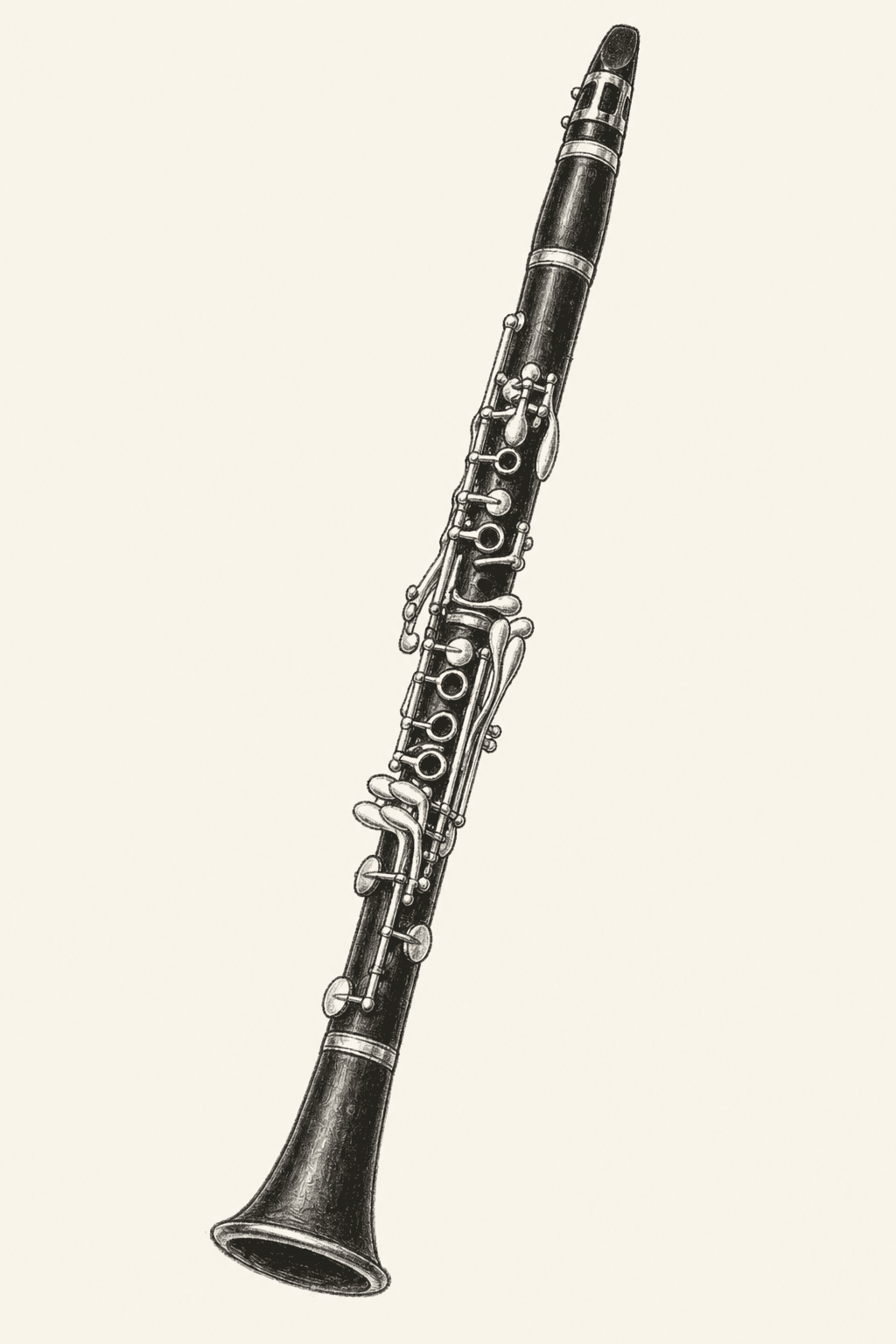
A slender cylinder some two feet in length — five jointed pieces of grenadilla, a single reed, and a small flared bell.
The clarinet is, alone among the orchestra’s principal woodwinds, a cylindrical bore — and that single fact governs everything. Where the oboe and bassoon flare, where the flute is open at both ends, the clarinet is closed at the mouthpiece by its single reed and remains a column of constant width almost to the bell. From this geometry come its great gifts: a chalumeau register dark and woody, a clarion brilliant and clear, and the famous twelfth between them — the register break that every clarinettist crosses ten thousand times in a career.
It is a transposing instrument, almost always — most often in B♭, sounding a major second below the page; in A, sounding a minor third below, when the music sits in sharp keys; and, more rarely, in E♭, smaller and brighter, sounding a minor third above. The orchestral player keeps both B♭ and A instruments at hand and switches between them as the key signature dictates. The composer should, too.
Mechanism
The clarinet is built of five principal pieces — mouthpiece, barrel, upper joint, lower joint, and bell — most often turned from grenadilla, an African blackwood close-grained enough to take the bore’s narrow tolerance. The single reed, of Arundo donax, is bound to the mouthpiece by a metal or fabric ligature; against it the player’s lower lip cushions the embouchure, and through it the breath is set vibrating.
Two systems of keywork divide the modern instrument. The Boehm system — devised by Klosé and Buffet in 1843, applying Boehm’s flute principles to the clarinet — is the standard nearly everywhere outside the German-speaking countries. The Oehler system, retained in Germany and Austria, is heavier in keywork and slightly darker in tone. For the composer the difference is largely invisible; for the player it is everything.
Voice and Character
Berlioz, who orchestrated as well as he wrote, called the clarinet the “epic instrument” of the woodwinds — the voice, in his catalogue, of heroic love and of distant, severe sentiment. He meant the clarion register; he might have meant the chalumeau just as easily. Few instruments cover so wide an emotional ground without seeming to change identity.
Its agility is unmatched among the woodwinds. Rapid scales, wide leaps, and the long-breathed lyrical line are all native to it; so is the glissando, which has belonged to the clarinet, in concert music, since Gershwin asked Ross Gorman for one in 1924. The instrument can whisper at the threshold of audibility and, ten bars later, cut clean through a tutti at the top of its clarion. Few instruments are asked to do so much, so often, and so well.
“The clarinet is little fitted to the expression of the naïve — its voice is that of heroic love.”
— paraphrased from Berlioz, Treatise on Instrumentation
Write for it as you would for a great singer of long lines — and remember that the same instrument, in the same hands, can also play the cat in Peter and the Wolf. Both are clarinet music, and the instrument knows no contradiction between them.
A slender cylinder some two feet in length — five jointed pieces of grenadilla, a single reed, and a small flared bell.
The clarinet flatters the careful composer and exposes the careless one. A handful of habits, kept in mind, will save many later revisions.
- i.Choose the right instrument for the key. B♭ clarinet for flat keys; A clarinet for sharp ones. Asking the player to read a string of double-sharps on the B♭ is asking the wrong question of the wrong instrument.
- ii.Know the break, and respect it. The crossing from throat A♯₄ to clarion B₄ is the instrument’s most awkward joint. Avoid quick alternation across it; if a passage demands the crossing, write it slurred and let the player place it.
- iii.Trust the chalumeau. The lowest octave is the instrument’s soul — woody, unhurried, and capable of a pianissimo no other woodwind can match. A long low line, marked dolce, will always be the right answer somewhere in a score.
- iv.Notate in treble clef, always. Even the bass clarinet reads treble in modern practice. Never depart from this without reason; the player has read treble all his life.
- v.Write fast, and write quietly. The clarinet can articulate scales at speeds the oboe and bassoon cannot reach, and at dynamics neither can sustain. Both are gifts. Use them — and remember that the player still has to breathe.
Beyond these few rules, write with the player in mind. A clarinettist will tell you what is possible — and, more usefully, what is beautiful.
The full compass — written
Written E₃ to C₇ — sounding a major second lower on the B♭ instrument, a minor third lower on the A.
The compass extends from a written E₃ — the bottom of the chalumeau, named for the Renaissance ancestor that gave the register its name — to a high C₇ in skilled hands, and beyond on rare occasion. Four regions repay study.
Chalumeau
The instrument’s soul — dark, woody, and slow to crowd. The chalumeau will hold a hall at pianissimo when no other wind in the orchestra can; it carries the cat of Peter and the Wolf, and the long evening of the Pathétique. Use it without apology.
Throat
The transitional notes. Thinner and less resonant than either neighbour, and disinclined to be exposed. Move through them; do not linger. The break to the clarion sits at the top of this register, and is the instrument’s most awkward seam.
Clarion
Bright, focused, and the clarinet’s public voice — the register of Mozart’s concerto and of every great solo in the symphonic literature. Carries through a tutti at full strength, and shapes a slow line at any dynamic from forte to the merest ghost.
Altissimo
The extreme upper reach. Pinched, brilliant, and sometimes shrill — the territory of specialists and of the climactic moment. Reserve it for music that has earned it; intonation is fragile and asks of the player a careful embouchure.
A slender cylinder some two feet in length — five jointed pieces of grenadilla, a single reed, and a small flared bell.
Of all the orchestra’s woodwinds, the clarinet possesses the widest technical vocabulary — and the longest history of adapting itself, without complaint, to whatever the music has lately required of it. Its agility, its dynamic range, and the strange willingness of the single reed to do almost anything asked of it have made the instrument, by quiet consensus, the most versatile member of its family. What follows is a sketch of that vocabulary as the modern composer is likely to use it.
Standard techniques
Articulation is, in classical practice, almost universally single-tongued. Double and triple tonguing exist on the clarinet, and a small number of virtuosi have made them their own, but the single tongue is so quick — and the reed’s response so immediate — that the orchestral repertoire has rarely needed more. The clarinet’s legato is its most envied possession: a slurred line across the break, well placed, will carry the longest melodic spans in the woodwind literature. Brahms, in the late chamber music, and Rachmaninoff, in the Second Symphony, ask exactly this of the player and reward it without exception.
Vibrato is used sparingly in classical practice — historically not at all, in the orchestral tradition — though jazz and modern playing have softened the rule, and a few players apply a discreet vibrato to long lyric lines. The instrument’s great glory is its dynamic control: it can begin a note from niente and grow to fff across many bars, and reverse the journey with equal grace. No other woodwind matches it. Use the privilege. Tonguing patterns — staccato, marcato, the famous portato — are all native to the instrument; rapid articulated scales lie under the player’s fingers in a way that the oboe’s and bassoon’s do not.
Extended techniques
Flutter-tongue (Flatterzunge) is among the most idiomatic of the extended techniques. Strauss and Mahler used it habitually, and the modern player produces it with ease across the compass. Glissando belongs to the clarinet by inheritance — Gershwin’s Ross Gorman improvised the opening of Rhapsody in Blue in 1924, and the smear has been part of the instrument’s repertoire ever since. It is achieved by a combination of slow finger release and embouchure pressure; the player will know how. Multiphonics are available throughout the range, though their character is sharper and more astringent than the oboe’s or bassoon’s.
Slap tongue, of jazz origin, has entered the modern classical repertoire and produces a percussive, pitched click useful in rhythmic textures. Microtones by alternate fingerings and partial covering of the holes are in regular use among contemporary specialists. Key clicks, growls, subtones, and breath sounds are all idiomatic; the instrument accepts them naturally. Circular breathing is practised by a small number of players and gives the clarinet, alone among woodwinds, a credible claim to the indefinite sustain. None of these effects should be assumed by the composer, but most can be had by asking.
Beyond all of this remains the central truth of the instrument: that its plain singing voice — used with intelligence, marked dolce, set in the chalumeau or the upper clarion — is still the thing the clarinet does best, and the thing it is most often asked for. Honour that, and the rest will follow.
A slender cylinder some two feet in length — five jointed pieces of grenadilla, a single reed, and a small flared bell.
A short, partial list — five places to begin if one wishes to know what the clarinet can do, and what it has been asked to do by composers who loved it.
- № 01
Mozart — Concerto in A, K. 622
Adagio
Written for the basset clarinet of Anton Stadler in the last weeks of Mozart’s life — the instrument as singer, and the slow movement that every clarinettist plays once and remembers always.
Listen on Spotify - № 02
Gershwin — Rhapsody in Blue
Opening
A trill, then a glissando from low G up nearly two and a half octaves — improvised, in 1924, by Ross Gorman, and never written any other way since.
Listen on Spotify - № 03
Tchaikovsky — Symphony No. 6, Pathétique
First movement, descent
A long solo that fades, marked pppppp, into the silence from which the bassoon will rise. Few passages in the literature ask so much of so little air.
Listen on Spotify - № 04
Rachmaninoff — Symphony No. 2
Third movement, Adagio
A long-breathed solo above a hush of strings — among the longest unbroken melodic lines ever written for the instrument, and a quiet test of stamina and tone.
Listen on Spotify - № 05
Brahms — Clarinet Quintet in B minor, Op. 115
Adagio
Written late, for Richard Mühlfeld, with whom Brahms had fallen quietly in love with the instrument. The clarinet sings, and the strings let it.
Listen on Spotify
Further entries will be added as our study deepens.
A slender cylinder some two feet in length — five jointed pieces of grenadilla, a single reed, and a small flared bell.
The clarinet was the invention, around the year 1700, of Johann Christoph Denner of Nuremberg — a maker of recorders and chalumeaux who, in adding a single key to the older single-reed chalumeau, opened to it a second register a twelfth above the first. The new instrument was, in its earliest form, a clarinet only by courtesy: two keys, a narrow compass, and a tone bright enough to recall the small trumpets — the clarini — from which it took its name.
The Classical instrument
By the middle of the eighteenth century the clarinet had grown to five keys and was beginning to find its composers. Stamitz wrote for it in Mannheim; Mozart, late in his life, wrote for it everywhere — in the operas, the symphonies, the great quintet of 1789, and the concerto of 1791, both made for his friend Anton Stadler. With Mozart the clarinet acquires, for the first time, the full vocal line that has been its inheritance ever since.
Müller and the modern keywork
The thirteen-key instrument of Iwan Müller, presented in Paris in 1812, was the first clarinet on which a player could reasonably hope to play in any key. Müller’s system gave the instrument the chromatic completeness Beethoven, Weber, and Schubert had begun to demand of it; Weber’s two concertos and the great clarinet quintet date from these same years, and would not have been possible on the older instrument.
Boehm and Oehler
The nineteenth century closed with two divergent settlements. In Paris, Hyacinthe Klosé and the firm of Buffet adapted the ring-key principles of Theobald Boehm’s flute to the clarinet, producing in 1843 the system that bears Boehm’s name and that has spread almost everywhere outside the German-speaking countries. In Germany, Oskar Oehler refined the older Müller pattern into the heavier, slightly darker instrument still played in Vienna and Berlin. Both traditions continue. Both produce great players.
The modern instrument
The clarinet of today is, in its essentials, the instrument of the late nineteenth century — refined, but not transformed. The orchestral player carries B♭ and A instruments and switches as the key dictates; the smaller E♭ and the bass clarinet wait at the side. From Brahms’s late chamber music to Gershwin’s glissando to the Copland concerto, the modern repertoire has continued to discover what Mozart already knew — that the clarinet is, perhaps, the most vocal of the woodwinds, and the most patient.
Specifications
A summary, for the composer’s desk.
- Family
- Woodwind, single reed
- Italian
- Clarinetto
- German
- Klarinette
- French
- Clarinette
- Range
- Written E₃ — C₇; treble clef
- Transposition
- Most often in B♭ (sounding a major second lower) or in A (sounding a minor third lower)
- Length
- Approx. 67 cm (B♭ instrument)
- Bore
- Cylindrical, of grenadilla; single reed on a beak mouthpiece
- Origin
- Nuremberg, c. 1700