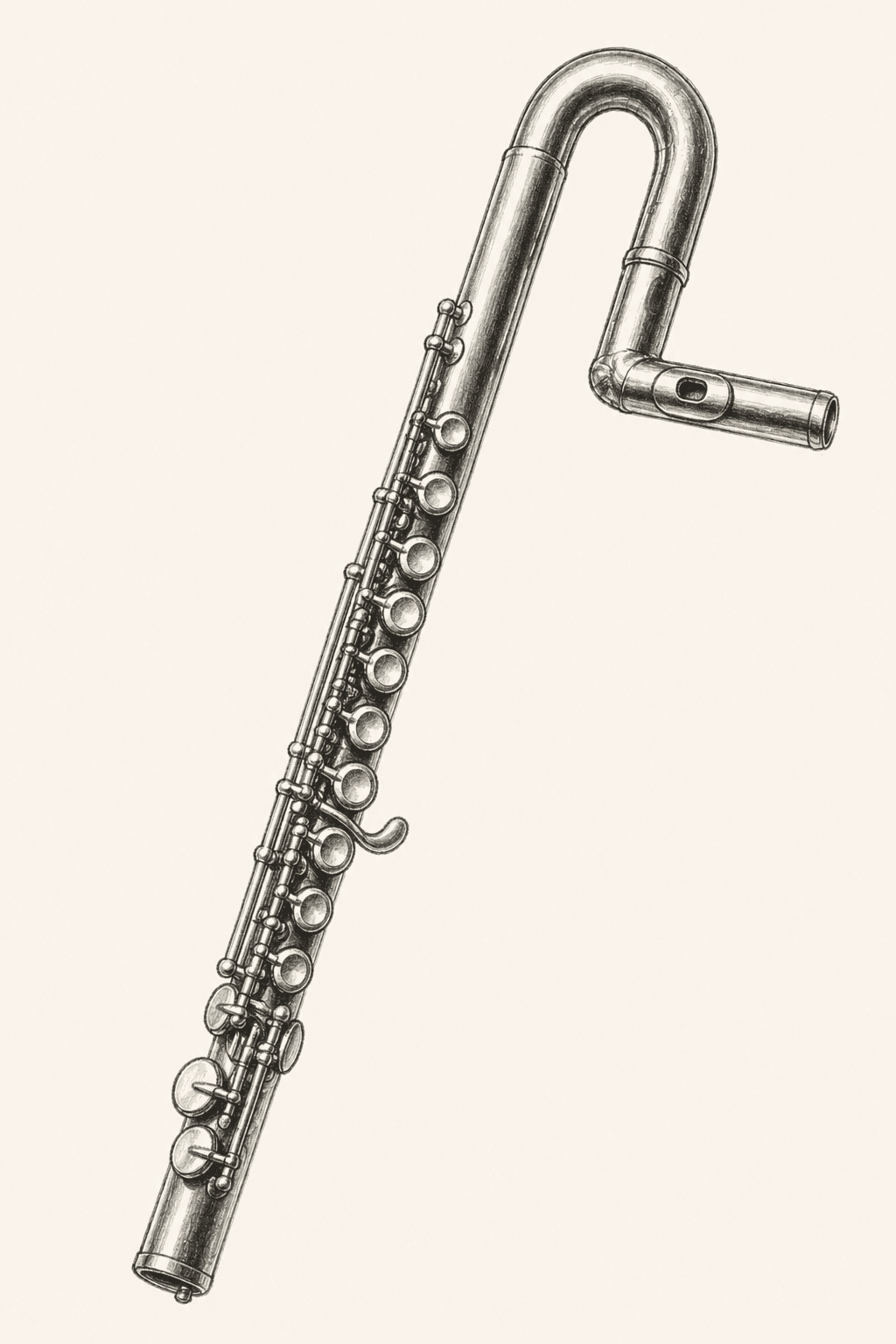
Twice the length of the concert flute — its head joint folded into a J, that the player may reach the lip plate at all.
The bass flute is the concert flute’s solemn cousin — pitched an octave below it, twice as long, and altogether quieter than its size would suggest. Its tone is breath made nearly visible: a low, hollow, almost choral colour that no other woodwind in the orchestra can match. To hear it well one must listen in a kind of silence; the instrument does not project, it confides.
It is a young instrument, by orchestral standards — a creature of the early twentieth century, born twice in the same decade, in Milan and in London. It remains rare. A composer who calls for it must usually also explain it; a flautist who plays it generally arrived from the concert flute and, on the night, will return there. Yet the few passages written for it tend to be remembered.
Mechanism
The instrument is, in plain terms, a flute of about a hundred and forty-six centimetres — twice the length of the concert flute and therefore impossible, without help, for the human arm to span. The usual remedy is the J-shaped head joint: a tube doubled back upon itself so that the embouchure hole sits within reach of the player’s lips while the body extends downward toward the floor.
The keywork is, again, the Boehm system — extended, levered, and sometimes coupled by long rods to bring distant tone-holes under the finger. The fingering is the flute’s own; the response is not. Air is spent prodigally. The bass flute is the most demanding member of the family for the breath, and the most easily lost in any texture thicker than a whisper.
Voice and Character
The instrument speaks at its best in its lower octave, where the tone is round, woody, and faintly veiled — a colour that can suggest the old wooden flutes of the Baroque, or the breath of a singer too tired to use words. Higher up, the voice thins and pales; the bass flute does not gain brilliance with altitude as the concert flute does. It loses it.
For this reason composers who love the instrument tend to keep it low. Reich, in Vermont Counterpoint, lays it across the floor of the texture; Schwantner uses it in chamber settings, lit from one side. The bass flute will not lead a tutti. It will, however, change the colour of one — a single sustained low note, quietly added beneath the strings, will alter the room.
“The bass flute is the flute remembering it once was a length of bone.”
— paraphrased, after a remark by a contemporary flautist
Among the woodwinds it is the rarest of the regular faces — and, perhaps because of that rarity, the easiest to mis-write. Score it as a colour, not a soloist; ask of it stillness, not speed; and the instrument will repay the patience with a sound that nothing else can imitate.
Twice the length of the concert flute — its head joint folded into a J, that the player may reach the lip plate at all.
The bass flute is unforgiving of haste and indifferent to volume. A few habits, kept in mind, will make the difference between a phrase the player cherishes and one nobody can hear.
- i.Stay low. The lowest octave is where the instrument is most itself. The middle is serviceable, the upper thin and effortful — and rarely worth the climb.
- ii.Spare the breath. Of all the flutes the bass is the most air-hungry. Give phrases room to end, and rests room to be taken; the player will be silently grateful.
- iii.Score around it, not above it. A bass flute under tutti strings is a bass flute lost. Thin the texture before you call on its voice — or accept that it will be felt, not heard.
- iv.Notate at written pitch. Treble clef, sounding an octave below — the convention is settled. Do not be tempted into bass clef or octave-displaced shorthand; the player has read a thousand parts in this format.
- v.Allow the change. Most bass flutes appear in works that ask the second or third flautist to double. Build a few empty bars before and after; the instrument is large, and so is the change of mouth.
Beyond these few rules, write with the player in mind. A flautist will tell you what is possible — and, more usefully, what is beautiful.
The full compass (written)
C₄ to C₇ as written — sounding an octave lower throughout.
The compass mirrors the concert flute’s on the page — middle C₄ to a high C₇ — but every note sounds an octave lower. The instrument is at its best below the staff, and grows steadily less convincing as it climbs. Four regions repay study.
Grave
The instrument’s heart. Round, woody, almost choral — the colour for which the bass flute exists at all. Easily covered by anything; reserve it for thin textures and quiet ground.
Medio
A serviceable middle, less distinctive than the low — the bass flute here can begin to resemble a slightly tired concert flute. Useful, but rarely the reason to call for the instrument.
Acuto
The instrument loses, rather than gains, character as it climbs. Tone thins, intonation tightens, and the bass flute begins to sound effortful. Use only with reason.
Sopracuto
The territory of specialists and contemporary writing. Pale, pinched, and rarely beautiful in ensemble; ask for it only when the music has earned the strangeness it will bring.
Twice the length of the concert flute — its head joint folded into a J, that the player may reach the lip plate at all.
The bass flute, large and slow-spoken, lends every technique it borrows a heavier weight. Articulations land later; key mechanisms sound nearly pitched; the instrument’s breath is, even at rest, present at the edge of the tone. The modern flautist who comes to the bass flute does not simply transfer technique from the smaller instrument — the bass demands a separate set of habits, and rewards them.
Standard techniques
Single tonguing is clean within reasonable tempi; double and triple tonguing are possible but rarely advisable, the slower bore and heavier air column working against rapid clarity. The bass flute is, by temperament, a legato instrument: sustained intervals, slow turns, dolce lines. Long phrases written without breaths will be played, but the dynamic envelope will narrow toward the end; build rests into the line, not after it.
Vibrato is broad, slow, often nearly absent — the instrument’s natural tone has so much breath at its core that further oscillation tends to obscure rather than enliven it. Dynamic projection is the perennial limit. A true forte from the bass flute, even in its best octave, is no louder than a mezzo-piano on the concert flute. Score around it; thin the texture; and any dynamic written becomes audible. Score against a tutti, and nothing written matters.
Extended techniques
The bass flute’s scale and slowness make it, paradoxically, the most idiomatic of the flutes for many extended effects. Key clicks are unusually audible — the larger pads producing a deeper, more nearly pitched percussion than on the C or alto flute — and have become a common percussive colour in contemporary ensemble writing. Tongue rams are particularly effective: the sudden stoppage of the airstream against the lip plate produces a low, drum-like attack that carries surprisingly well, sounding roughly a major seventh below the fingered note.
Flutter-tongue in the lowest octave is a slow, granular rumble — the instrument’s most cinematic colour. Multiphonics are abundant, often quite stable, and frequently more beautiful than on the smaller flutes; the bass flute’s multiphonic chords can hold their pitches for several seconds at a useful dynamic. Whistle tones emerge slowly but speak with an unusual depth of glaze; harmonics, overblown from the lowest fingerings, lend a veiled colour that the natural notes cannot equal.
The jet whistle, singing while playing, microtones through altered fingerings, and circular breathing all transfer from the C flute and gain, in the bass, a heavier and more ritualistic character. Of all the flutes, this is the one most readily heard as a thing not quite of the present — and its extended techniques have, for that reason, become its most characteristic music.
Twice the length of the concert flute — its head joint folded into a J, that the player may reach the lip plate at all.
A short, partial list — five places to begin if one wishes to know what the bass flute can do, and what has been asked of it by the composers who, here and there, remembered it was in the room.
- № 01
Steve Reich — Vermont Counterpoint
For eleven flutes, live and pre-recorded
A web of overlapping pulses in which the bass flute holds the floor — the foundation that lets the high voices flicker above it.
Listen on Spotify - № 02
Henry Brant — Angels and Devils
Concerto for flute with ten flutes
A 1931 oddity that nonetheless enshrines the bass flute in the orchestral imagination — heard mostly as colour and weight beneath the soloist.
Listen on Spotify - № 03
Pietro Mascagni — Parisina
Scored for Albisi’s albisifono
One of the earliest places the bass flute was given operatic light. Mascagni, Puccini, and Leoncavallo all wrote for Albisi’s instrument before silence reclaimed it.
Listen on Spotify - № 04
Joseph Schwantner — Black Anemones
For flute or bass flute and piano
A slow, dark song without words — the kind of writing the bass flute was, perhaps, invented to make possible.
Listen on Spotify - № 05
Benjamin Yusupov — Nola Concerto
For bass & contrabass flute, strings, percussion
A late-twentieth-century concerto that takes the lowest flutes seriously as soloists — neither shadow nor novelty, but principal voice.
Listen on Spotify
Further entries will be added as our study deepens.
Twice the length of the concert flute — its head joint folded into a J, that the player may reach the lip plate at all.
The bass flute is among the youngest members of the woodwind family. It was born twice in the early twentieth century — once in Milan, in the workshop of an Italian flautist who wanted a deeper voice for the opera house, and once in London, in a firm of British makers whose instruments would set the modern standard.
Albisi’s albisifono
In 1910 Abelardo Albisi, principal flautist at La Scala, patented an instrument he called the albisifono — an upright bass flute with a B foot, fingered by Boehm system and held vertically against the body. Mascagni wrote for it in Parisina; Puccini and Leoncavallo followed. For a brief period it was, in the Italian operatic imagination, simply the bass flute. The instrument did not survive its inventor by long.
Rudall, Carte & Co.
In London, the firm of Rudall, Carte & Co. arrived at the problem differently. Their bass flute in C, codified through the nineteen-twenties and -thirties, took the transverse form of the concert flute and lengthened it — folding the head joint into a J so that the player could reach the embouchure at all. It is this instrument, refined since, that any modern flautist will recognise.
The mid-century
For decades after its invention the bass flute remained largely a curiosity. Henry Brant, in Angels and Devils of 1931, scored a flute concerto for an ensemble of ten flutes including bass; a handful of film composers used it, sparingly, for shadow. The mainstream symphonic tradition did not. Where a darker flute was wanted, the alto flute — pitched a fourth lower than the concert — almost always answered.
The contemporary instrument
The bass flute’s reputation, such as it is, was made in the late twentieth century. Steve Reich’s Vermont Counterpoint of 1982 placed it in the foundation of a great minimalist texture; composers around Sciarrino, Schwantner, and Yusupov took it seriously as a soloist. Today it lives most readily in flute choirs, chamber works, and film scores — a quiet, present-tense instrument, still finding its repertoire.
Specifications
A summary, for the composer’s desk.
- Family
- Woodwind, transverse flute
- Italian
- Flauto basso
- German
- Bassflöte
- French
- Flûte basse
- Range
- Written C₄ — C₇; sounding C₃ — C₆
- Transposition
- Sounds an octave below written; treble clef
- Length
- Approx. 146 cm (57″)
- Head joint
- J-shaped, to bring the embouchure within reach
- Material
- Silver, sometimes silver-plated brass
- Origin
- Italy & Britain, early 20th century