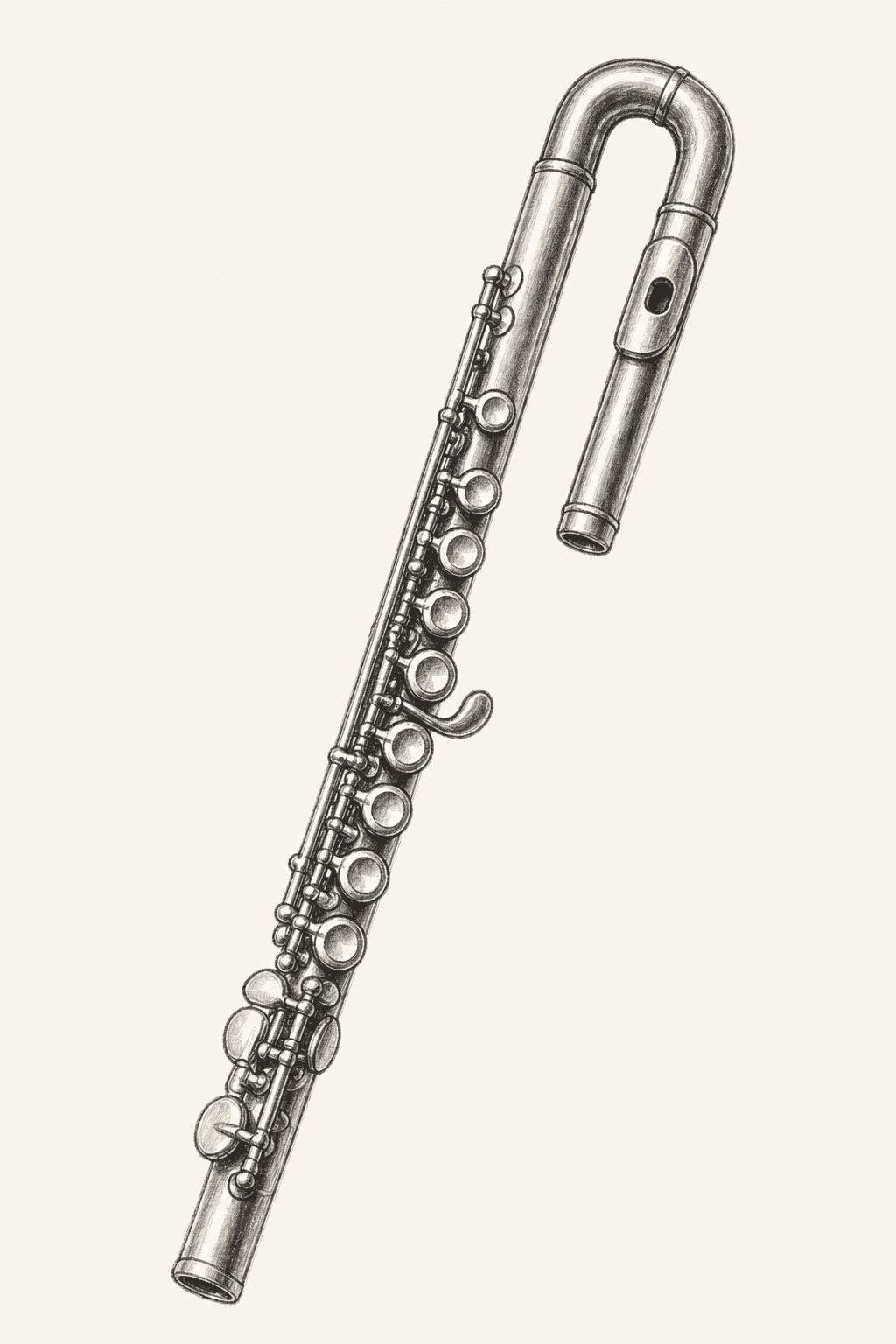
A cylindrical silver tube of some thirty-four inches — its headjoint often curved, that the player’s arms might reach the keys without strain.
The alto flute is a flute that has been pulled, gently, toward the contralto voice. Its tube is longer; its bore is wider; its lowest notes — a fourth below those of the orchestral flute — speak with a density and a faint hoarseness that the C flute does not possess. It is, in temperament, the most introspective member of the flute family, and the register every great orchestrator has reached for when the ordinary flute would say too much.
Pitched in G, it transposes a perfect fourth lower than written, so that the composer reads in a familiar treble compass while the player sounds darker than the eye expects. Above all, it is a quiet instrument. Its lowest octave will not project against a tutti; it wants thin scoring, careful muting, the patience of an open texture. Give it those, and it will give you Daphnis.
Mechanism
The alto flute is built on the Boehm system, like its sibling the C flute — a cylindrical bore, a parabolic headjoint, and the same array of ring keys and pads laid out across three joints: head, body, and foot. The tube is generally of silver, the bore noticeably wider than that of the smaller flute, and the headjoint is offered in two shapes — straight, for clarity of tone, and curved, for reach. Most professional players keep both.
The embouchure plate is correspondingly larger, and the air column slower to set in motion. Players speak of the alto flute as “consuming” air; a phrase that, played without a place to breathe, will end before the player meant it to.
Voice and Character
Stravinsky, who used the alto flute among the first to write seriously for it, valued its lowest octave for what he called its “velvety, cold” tone — the quality of a voice softened by wool. The instrument is at its finest there, in the low fifth from sounding G to D, where the breath becomes audible at the edge of the tone and the line takes on a faintly archaic colour. Above the staff it brightens, but never altogether; the alto flute does not, in any register, glitter.
It is, accordingly, the orchestra’s native instrument of half-light. Ravel reaches for it at dawn; Holst at the edge of the solar system; Strauss in the cool air of an alpine meadow. The alto flute does not announce. It hovers — and the moment it enters, the room appears to cool by a few degrees.
“The alto flute speaks softly, but it is heard further than it has any right to be.”
— paraphrased, after a remark of the orchestral lore
Use it where you would otherwise reach for a muted horn, a low oboe, or the dampened cellos at the back of the section. Use it, above all, for that thing the C flute cannot do — speak quietly, in the dark, and still be believed.
A cylindrical silver tube of some thirty-four inches — its headjoint often curved, that the player’s arms might reach the keys without strain.
The alto flute is generous to the considered composer and unkind to the cluttered one. A few habits, kept in mind, will keep the instrument heard.
- i.Score thinly around it. The low register will not cut through a forte tutti. Strip the texture; mute what remains; let the instrument be the line, not a colour within one.
- ii.Treat the low fifth as the voice. From sounding G to D the alto flute has its richest air. Most great solos written for the instrument live there; let yours, too.
- iii.Transpose, and then read again. Written in G — sounding a perfect fourth lower. Spell the part in the treble clef as for a flute, and check the sounding pitch against everything that surrounds it.
- iv.Allow for the breath. The wider bore takes more air than the C flute. Long phrases without rest will be played, but at a cost; written rests are the gift the player most often remembers.
- v.Spare the extreme high register. Above sounding D₆ the tone narrows and tires; the C flute will almost always do the same work better. Reserve the top for moments the music has earned.
Beyond these few rules, write with the player in mind. A flautist will tell you what is possible — and, more usefully, what is beautiful.
The full compass (written)
Written C₄ to C₇ — sounding a perfect fourth below, G₃ to G₆.
The compass is, on the page, that of the orchestral flute — a written C₄ to a written C₇ in skilled hands. In the air it is a fourth lower throughout, sounding from G₃ to G₆. Four regions repay study.
Basso
The celebrated low fifth. Velvety, breathy, faintly archaic — the very tone Ravel asked for at dawn over the meadow. Score thinly; mute the surroundings; never expect it to compete with brass.
Medio
The singing middle of the instrument. Supple and clear, a touch warmer than the C flute at the same pitch. The natural register for sustained melody at any dynamic.
Acuto
Bright, but never glassy. The instrument loses some of its native dusk here; passages that would suit the C flute equally are usually better given to the C flute.
Sopracuto
The extreme upper reach. Thin and effortful; the territory of specialists, and rarely written for. Reserve it for moments the music has earned.
A cylindrical silver tube of some thirty-four inches — its headjoint often curved, that the player’s arms might reach the keys without strain.
The alto flute inherits the C flute’s vocabulary and inflects it with its own slower temperament. Articulations arrive a fraction later; the breath is more audible at the edge of the tone; and many of the modern effects that sound novel on the C flute sound, on the alto, like things the instrument was waiting to be asked.
Standard techniques
The wider bore is slower to speak than the C flute’s — particularly in the low register, where notes want a moment of air before they settle. Single tonguing is clean and unhurried; double and triple tonguing are available, but markedly less brilliant than on the smaller instrument, and rarely the reason a composer reaches for the alto in the first place. Long legato phrasing is the alto flute’s native domain — slow intervals, sustained dolce lines, the unhurried rise and fall that Ravel and Stravinsky drew from it.
Vibrato tends to be broader and slower than the C flute’s — a darker oscillation, in keeping with the instrument’s temperament. Dynamics in the low register are limited at the loud end; the alto flute will not project a true forte from sounding G to D, and any dynamic written there must be read against the surrounding texture. The middle and upper registers behave more nearly as the C flute’s do, though always with a residue of the instrument’s shadow.
Extended techniques
Almost everything the C flute will do at the edges of its repertoire, the alto will do — and often better. Flutter-tongue in the low register is a granular, quietly menacing colour, and one of the instrument’s most distinctive modern effects. Key slaps and key clicks sound deeper and more pitched than on the C flute, the larger pads producing a more resonant percussion. Multiphonics are abundant and frequently very beautiful — the instrument’s wider bore yields chords that the C flute cannot quite match in stability or fullness.
The jet whistle sounds at a lower pitch and with a heavier body of air; whistle tones, those faintest of harmonic partials, take a moment longer to find but speak with a darker glaze. Harmonics overblown from low fingerings are softly veiled — useful where the natural note would say too much. Tongue rams, microtones, singing while playing, and circular breathing all transfer from the C flute, with the alto’s characteristic darkening of every effect. The instrument does not glitter; it broods. Its modern colours brood too.
A cylindrical silver tube of some thirty-four inches — its headjoint often curved, that the player’s arms might reach the keys without strain.
A short, partial list — five places to begin if one wishes to know what the alto flute can do, and what it has been asked to do by composers who loved it.
- № 01
Ravel — Daphnis et Chloé
Lever du jour
A long, dark line in the low register — the alto flute’s great solo, woven into a slow dawn of strings.
Listen on Spotify - № 02
Stravinsky — Le Sacre du printemps
Rondes printanières
Among the first appearances of the instrument in the modern orchestra — smoky, ritualistic, low.
Listen on Spotify - № 03
Holst — The Planets
Neptune, the Mystic
Two flutes and an alto in muted ostinato — the orchestra dissolving into mist before the offstage chorus.
Listen on Spotify - № 04
Strauss — Eine Alpensinfonie
Auf der Alm
A pastoral interlude of cowbells and woodwind — the alto flute laid into the ensemble like a darker reed of light.
Listen on Spotify - № 05
Copland — Appalachian Spring
Opening
A held G in the low register — the prairie at first light, quiet and exact.
Listen on Spotify
Further entries will be added as our study deepens.
A cylindrical silver tube of some thirty-four inches — its headjoint often curved, that the player’s arms might reach the keys without strain.
The alto flute is a child of the nineteenth century, and of one particular workshop. Theobald Boehm — the Bavarian goldsmith, flautist, and engineer who, in 1847, gave the modern flute its cylindrical bore and its ring-keyed mechanism — turned in his later years to the lower members of the family. The flute in G, larger and softer of voice, was the most successful of these later designs.
Boehm’s flute in G
Boehm built his first alto flutes in Munich in the 1850s. He thought the instrument the most expressive of all flutes — a remark that has often been repeated, and that the makers who followed him took seriously. The early instruments were of wood with silver keywork; the all-silver alto flute, lighter and more even of tone, came a generation later.
Entry into the orchestra
The alto flute waited fifty years for an orchestra to claim it. It was Rimsky-Korsakov who first scored for it as such, and Stravinsky — taught by Rimsky — who fixed it in the orchestral imagination, first in The Rite of Spring and again in The Firebird. Ravel’s use of the instrument in Daphnis et Chloé followed almost at once; Holst inherited from him; and by the 1920s the alto flute was, if not yet a regular member of the orchestra, no longer an exotic.
Curved and straight
The most visible refinement of the twentieth century was the curved headjoint, which folded the long tube back upon itself and brought the keys within reach of the player’s left hand. Many alto flutes are sold with both — straight, for the clearest tone, and curved, for the ease of longer engagements. Player and conservatory both have their preferences; the music itself is indifferent.
The modern instrument
The alto flute as it stands today is, in essence, Boehm’s instrument with a century and a half of small refinements: better pads, more even keywork, an embouchure plate cut to a shape arrived at by long experiment. Composers from Britten and Copland through Boulez and Saariaho have written for it without ceasing. It is, by the standards of the orchestra’s lower auxiliaries, an instrument that has quietly come to stay.
Specifications
A summary, for the composer’s desk.
- Family
- Woodwind, transverse flute
- Italian
- Flauto contralto
- German
- Altflöte
- French
- Flûte alto
- Range
- Written C₄ — C₇; sounding G₃ — G₆
- Transposition
- In G — sounds a perfect fourth below written
- Length
- Approx. 86 cm (34″)
- Headjoint
- Straight or curved, of silver or silver alloy
- Bore
- Cylindrical; wider than the C flute
- Origin
- Germany, mid-19th century — Theobald Boehm