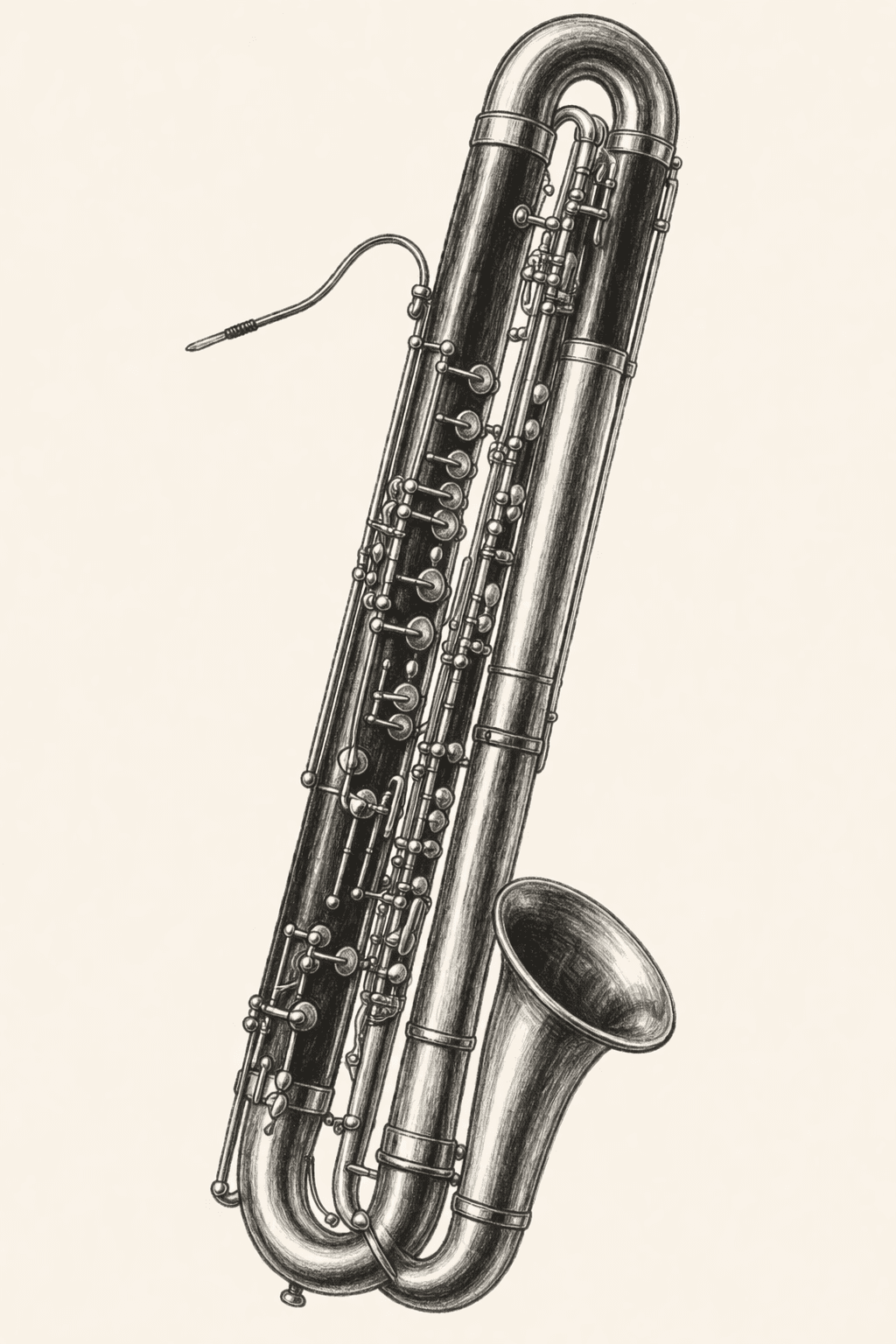
Eighteen feet of conical tubing, folded four times — the instrument stands upon a spike, the bell turning earthward like a great wooden trumpet.
The contrabassoon is the orchestra’s deepest woodwind — a bassoon descended an octave, but transformed in the descending. Its bore, unfolded, would stretch the length of a small room; its lowest note lies a tone beneath the lowest pitch of a five-string bass; and its sound, at the foot of the orchestra, has a peculiar gravity that no other instrument quite supplies.
It is, in temperament, a creature apart from the bassoon. Where the bassoon confides, the contrabassoon mutters. Where the bassoon sings, the contrabassoon broods. Composers reach for it when the music must sit deeper than the basses themselves — Brahms in the first symphony, Ravel in Ma mère l’Oye, Strauss almost everywhere — and ask of it not melody, as a rule, but ground.
Mechanism
The instrument is built of maple, like the bassoon, but on a scale that requires four folds rather than two — so that an eighteen-foot column of air may be carried by a single seated player. A long, sweeping bocal rises from the side of the body to receive the reed, which is broader and softer than the bassoon’s. The bell most often turns downward, toward the floor, though older models and some modern variants direct it upward or sideways.
The keywork descends from Heckel’s designs of the late nineteenth century, and the modern instrument is, in essence, his. A spike at the foot bears the considerable weight; the player sits behind the instrument rather than holding it, and reads — by long convention — from a part written one octave above sounding pitch, to spare the page a forest of ledger lines.
Voice and Character
The contrabassoon is, at its lowest, less a pitch than a vibration. Its fundamental tones can be felt in the body before they are heard in the ear, and a quiet pedal in the deepest register has the effect of darkening every other instrument that sounds above it. Higher in its compass — where it overlaps with the ordinary bassoon — it loses much of this peculiar quality and becomes a paler, throatier version of its cousin.
Like the bassoon it has its comic side, and Ravel knew it best: the Beast of Ma mère l’Oye is at once grave, courteous, and absurd — a portrait drawn in three minutes that no other instrument could have provided. But its native register is solemn. Treat it as the orchestra’s pedal point, and it will repay you.
“A useful instrument, especially in a piano passage, where it lends the bass a heaviness that nothing else can give.”
— paraphrase, after Berlioz
The contrabassoon will rarely lead. Ask it instead to anchor — and the anchor it provides will steady everything written above it.
Eighteen feet of conical tubing, folded four times — the instrument stands upon a spike, the bell turning earthward like a great wooden trumpet.
The contrabassoon punishes inattention more than most. A handful of habits, observed, will keep the line playable and the player your friend.
- i.Write it an octave high. The part is by convention notated one octave above sounding pitch. Mark it clearly, and the player will thank you.
- ii.Give the low notes time. The bottom octave speaks slowly — the longer the bore, the more air it asks for. Quick passagework in the depths is rarely effective.
- iii.Use it as a foundation, not a soloist. The instrument doubles cellos and basses at the octave below to magnificent effect. Solo writing is possible, but choose the moment.
- iv.Avoid the highest reaches. Above the staff the tone thins and the intonation grows unreliable. Leave the upper register to the bassoon proper.
- v.Mind the breath, more than ever. An eighteen-foot bore drinks air. Phrases must be cut to a length the lungs can sustain — and a quiet rest must always be near.
Beyond these few rules, write to the instrument’s nature. The contrabassoon is not a small bassoon, and asking it to behave like one is to waste the gift it actually offers.
The full compass (written)
Written B♭₁ to F₅; sounding B♭₀ to F₄ — three and a half octaves, an octave below the bassoon.
The compass extends from a sounding B♭₀ — the lowest pitch in regular orchestral use — to a sounding F₄ at the top. Some modern instruments reach to a low A₀, a semitone deeper still. Four regions repay study; the staves below show written pitches.
Profondo
The deepest register — felt as much as heard. Pedal tones of remarkable gravity, slow to speak and unsuited to rapid figuration. Most often used as a sustained foundation beneath the basses.
Basso
The working register, where most of the orchestral writing for the instrument lives. Doubles cellos and basses richly; speaks with reasonable agility; supports the woodwind chord from below.
Tenore
Here the contrabassoon enters the bassoon’s singing range, but with a thinner, throatier voice. Solos in this register are possible — Ravel proved it — though the colour is unmistakably its own.
Acuto
The extreme upper reach. Pinched, uncertain in pitch, and rarely worth the trouble — the bassoon will do this work better. Reserve only for effects that require this exact, strained tone.
Eighteen feet of conical tubing, folded four times — the instrument stands upon a spike, the bell turning earthward like a great wooden trumpet.
The contrabassoon is, in expressive vocabulary, a slowed and deepened bassoon. Its eighteen feet of bore impose their own physics: every articulation is heavier, every leap longer in the air, every breath measured against a column that draws and gives with corresponding deliberation. The composer who understands this writes for the instrument as for a great pedal pipe with a reed at one end — and the contrabassoonist will repay that understanding without limit.
Standard techniques
The lowest register speaks slowly. The fundamental tones of the profondo are produced only by a substantial volume of air, and the reed — broader and softer than the bassoon’s — is less responsive to rapid articulation than its smaller cousin’s. For this reason the orchestral idiom of the instrument is chiefly sustained and pedal-like: held tones, slow scales, and moderate doubling of the cellos and basses at the octave below. Single tonguing is the rule; faster articulations are possible in the upper part of the compass but lose effect at the bottom, where the bore’s slow speech blurs them.
Legato slurring is the contrabassoon’s most natural mode, and Brahms, Mahler, and Strauss exploit it constantly: a slow rising line in the basso register, doubled an octave below the cellos, gives the orchestra a foundation that the basses alone cannot provide. Vibrato is used moderately and chiefly in solo writing. Dynamic control extends from a barely audible ppp — the most useful of the instrument’s dynamics, in which the lowest notes become felt rather than heard — to a sonorous f. Above the staff the breath cost rises sharply; build rests into the line accordingly.
Extended techniques
Flutter-tongue is particularly resonant on the contrabassoon — the long bore lends the effect a depth and growl no other woodwind can produce, and Strauss made early use of it as a colour of menace. Multiphonics are available, though they speak more slowly than on the bassoon; their character is sonorous and faintly buzzing, well suited to sustained contemporary textures. Microtones by alternate fingerings are within reach across most of the range; intonation in the lowest register is delicate at the best of times, and finer divisions there require negotiation with the player.
Key clicks sound clearly on the long body and have been used to atmospheric effect in modern scores. Glissando in any true sense is impossible — the keywork forbids it — though embouchure-driven bends across small intervals are practicable. The instrument is, in general, less agile than the bassoon, and most of its extended techniques are best treated as slow, sonorous events rather than rapid figures. The contrabassoon will not be hurried. It will, asked patiently, give back a depth no other instrument in the orchestra can match.
Eighteen feet of conical tubing, folded four times — the instrument stands upon a spike, the bell turning earthward like a great wooden trumpet.
A short, partial list — five places to begin if one wishes to know what the contrabassoon can do, and what it has been asked to do by composers who understood it.
- № 01
Ravel — Ma mère l’Oye
Les entretiens de la Belle et de la Bête
The Beast itself, lumbering up from below — perhaps the most famous solo ever written for the instrument.
Listen on Spotify - № 02
Brahms — Symphony No. 1
First movement, opening
A pulse low beneath the timpani, lending the introduction its terrible weight.
Listen on Spotify - № 03
Dukas — L’apprenti sorcier
Brooms unleashed
Sharing in the bassoons’ famous staccato — but a register lower, and twice as comic for it.
Listen on Spotify - № 04
Strauss — Salome
Dance of the Seven Veils
A sinister growl beneath the orchestra, audible as much through the floor as through the air.
Listen on Spotify - № 05
Mahler — Symphony No. 5
Fifth movement
Doubling the cellos and basses at the octave below — the rumbling foundation of the rondo.
Listen on Spotify
Further entries will be added as our study deepens.
Eighteen feet of conical tubing, folded four times — the instrument stands upon a spike, the bell turning earthward like a great wooden trumpet.
The contrabassoon’s ancestry runs back to the late seventeenth century, when German makers — chief among them Andreas Eichentopf of Leipzig — first attempted to extend the bassoon downward by an octave. The early instruments were ungainly, uncertain in pitch, and difficult to play; but they worked, and by the early eighteenth century the contrabassoon had begun to find a place at the bottom of the wind band.
The eighteenth century
Bach and Handel both wrote for it sparingly. Haydn used it in The Creation and The Seasons, where its low pedals underwrite the choruses with a peculiar grandeur. Beethoven took it up enthusiastically — the fifth, ninth, and the late masses all call for the instrument, and its lowest notes provide some of the characteristic darkness of those scores.
Heckel and the modern form
The instrument as we know it owes its existence chiefly to Wilhelm Heckel of Biebrich, who in 1879 produced the design that has been the standard ever since. Heckel’s contrabassoon — eighteen feet of maple folded four times, with the bell turning toward the floor — replaced a long line of less satisfactory predecessors and is, in its essentials, the instrument every orchestra plays today.
The late Romantic flowering
The decades after Heckel’s redesign were the contrabassoon’s greatest. Brahms, Mahler, Strauss, and Wagner all wrote for it habitually; Ravel gave it, in Ma mère l’Oye, the most beloved solo in its repertory; Stravinsky and Schoenberg used it with care, and the modernists have not abandoned it. It is now a permanent member of the symphony orchestra.
The instrument today
Modern makers have refined the keywork, extended the range — many instruments now reach down to a low A₀ — and experimented with materials, but the silhouette and the voice remain Heckel’s. A contrabassoonist trained in Vienna or Berlin, sat down before a score by Strauss, plays the instrument the composer imagined. There are not many orchestral instruments of which this is still true.
Specifications
A summary, for the composer’s desk.
- Family
- Woodwind, double reed
- Italian
- Controfagotto
- German
- Kontrafagott
- French
- Contrebasson
- Range
- B♭₀ — F₄ (sounding)
- Transposition
- Written one octave above sounding pitch; bass clef
- Length unfolded
- Approx. 5.5 m (18′)
- Reed
- Double, of Arundo donax — broader than the bassoon’s
- Origin
- Germany, late 17th century; modern form by Heckel, 1879