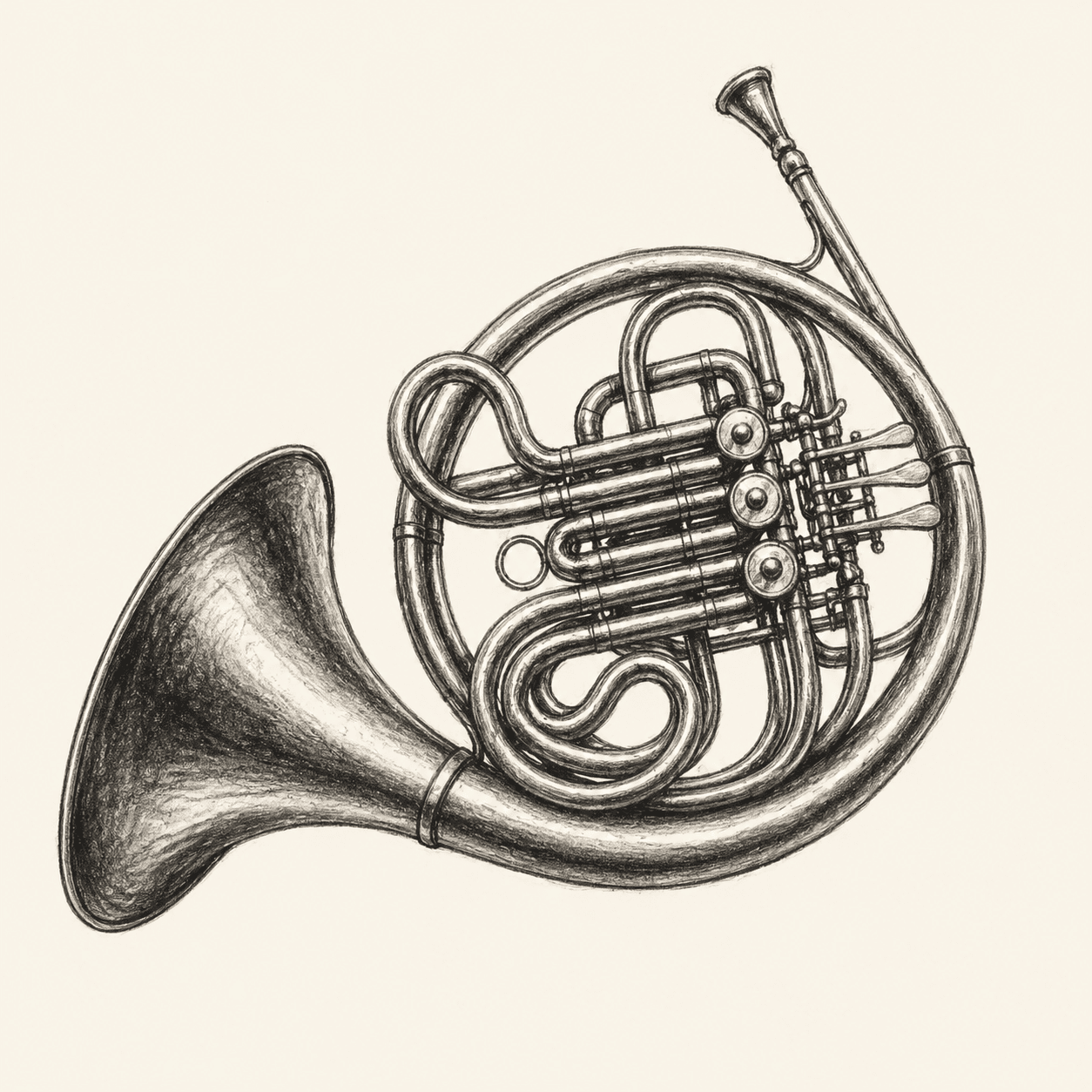
The instrument is, in essence, a conical tube of some twelve feet — wound twice upon itself and ending in a bell wide enough for the right hand to enter.
Of all the brass, the horn is the most reluctant member — and, by a wide margin, the most beloved. Its bore is conical where its neighbours are largely cylindrical; its tone is rounder; its high register sits, by nature, in a vertiginous corner of the harmonic series; and its right hand, of all things, lives inside the bell. The result is an instrument that can speak in turn nobly, mournfully, jubilantly, or in a half-hush — and which, more than any other, binds the orchestra together from within.
It is also an instrument of nerves. The principal horn is asked, night after night, to enter on a high note from cold breath, with no slide to adjust and no reed to blame. Schumann called it die Seele des Orchesters — the soul of the orchestra — and it is partly because the soul, by tradition, sings without a safety net.
Mechanism
The modern instrument is the double horn, two horns sharing a single bell: an F side of about twelve feet of tubing, and a B♭ side a fourth shorter. A thumb valve switches between them, allowing the player to choose the more secure pitch — F for warmth and the lower compass, B♭ for accuracy in the high register. Three rotary valves, operated by the left hand, lower the open pitch by a tone, a semitone, and a tone-and-a-half, in the familiar combinations of the brass.
The right hand sits inside the bell, where it tunes, colours, and — by further closure — produces the muffled, slightly metallic tone called stopped (German gestopft, French cuivré bouché), notated with a + above the note. It is the only orchestral instrument routinely played one-handed, and the only one whose interior is, in part, the player.
Voice and Character
Berlioz heard in the horn “a noble and melancholy character, in the soft passages — and a brilliance, in the loud ones, that few instruments can rival.” He was right on both counts. The horn at piano is a candle; the horn at fortissimo is a beacon; and the horn in the middle, where most of its life is lived, is the warm thread that runs through every great symphonic tutti.
It blends. That is the practical secret of it. Four horns will sit comfortably inside a string chord without erasing it, beneath a wind choir without crowding it, and beside the trombones without forfeiting their own colour. No other brass instrument is so good at being heard without intruding — and few wind instruments are so good at carrying weight.
“The horn is the soul of the orchestra.”
— Robert Schumann
Write for the horn as one writes for a singer who is also a hunter. The line should breathe; the high notes should be earned; and the instrument, given its time, will reward you with something no other voice in the orchestra can give.
The instrument is, in essence, a conical tube of some twelve feet — wound twice upon itself and ending in a bell wide enough for the right hand to enter.
The horn is forgiving in the middle of its compass and unsparing at the extremes. A handful of habits, kept in mind, will save many later revisions — and many a cracked entrance.
- i.Write in F, even if it strains the eye. The horn is a transposing instrument by long convention. Sound a perfect fifth below the written pitch, treble clef as a rule, bass clef when the line descends below the staff.
- ii.Cold entrances are the hard ones. A high exposed entry from silence asks much of the player. Give a bar or two of context, or accept that the risk is part of the music.
- iii.Write the horns in pairs, or in fours. Two horns will harmonise as a single voice; four will form a complete choir. The standard orchestral complement is four — first and third high, second and fourth low — and the assignments are not arbitrary.
- iv.Use the stopped tone with intention. Marked +, the stopped horn is small, metallic, and faintly distant — neither louder nor softer than the open tone, but unmistakably different in colour. Reserve it for moments the music has named.
- v.Mind the breath, and the rest after the high note. Sustained high writing tires the lip in a way that no other brass instrument quite shares. Build recoveries into the part, not around it.
Beyond these few rules, write with the player in mind. A horn player will tell you what is possible — and, more usefully, what is honest.
The full compass
B₁ to F₅ at sounding pitch — close to four octaves.
The compass extends from a dim pedal B₁ — rarely written, rarely missed — to a high F₅ in skilled hands, and occasionally beyond. The pitches given here are sounding pitches; written, the horn lives a perfect fifth higher. Three regions repay study.
Basso
Cavernous and a little awkward — the pedal tones of the F horn, fuzzy at the bottom and slow to centre. A region best entered deliberately, often by the third or fourth player; magnificent for shadow, treacherous for solo.
Tenore
The honeyed middle. Here the horn most resembles a baritone voice — full, round, perfectly secure — and here, in unison or chorale, the orchestra’s warmest brass writing tends to live.
Acuto
The singing high register, the natural home of the principal. The harmonics crowd close together here, which makes the player’s job harder; the writing, in skilled hands, more rewarding. Strauss and Mahler live here.
Sopracuto
The extreme upper reach. Thin, brilliant, perilous; the territory of specialists and of one or two famous solos. Reserve it for moments the music has earned, and grant the player time to find it.
The instrument is, in essence, a conical tube of some twelve feet — wound twice upon itself and ending in a bell wide enough for the right hand to enter.
The horn’s expressive vocabulary is among the broadest of any orchestral instrument — partly because the right hand, ever inside the bell, is in constant negotiation with the column of air, and partly because the instrument has carried with it, since the days of the chase, a long memory of effects no other brass possesses.
Standard techniques
The horn articulates by tongue and by lip in equal measure. Single tonguing serves most music; double and triple tonguing — the latter a specialty of the principal’s repertoire, audible in Strauss and the Brahms concertos — answer faster passagework. Slurred legato is the instrument’s native gait, and the lip slur, the gentle traversal of the harmonic series without valve change, is the horn’s most characteristic gesture: it is the call of the hunt itself, and the very thing the player learns first.
Mutes form a small family. The straight mute, of pasteboard or metal, gives a clipped and faintly nasal tone; transposition mutes, non-transposing mutes, and various wooden and fibre variants exist for particular colours. The right hand, however, remains the horn’s truest mute: half-stopped (notated + beneath a partially closed bell) the instrument turns small and metallic; fully stopped, at forte, it acquires the brassy snarl marked cuivré. Composers from Wagner onward have treated the stopped tone as part of the ordinary palette rather than as a special effect.
Extended techniques
Beyond the standard idiom the horn admits a number of further colours, most of them won at some cost to security. Flutter-tongue — a rolled r against the tongue or in the throat — gives a granular, faintly sinister rumble, particularly effective in the lower compass. Glissandi are possible across a single harmonic series with a slow valve change; through the bell, with the hand, a narrower portamento is also obtainable. Microtonal inflection, by lip and by hand position, is part of the natural-horn inheritance and survives wherever a composer asks for it.
Most singular of all is the multiphonic — the player sings one pitch while sounding another, the two beating against each other in the bell to produce, by combination, a chord of three or four audible tones. Weber experimented with the effect in his concertino, Schumann wrote it into the Konzertstück for four horns, and Ligeti and others have explored it since. Rips, falls, and bell tones — the latter passed from one horn to the next in a chord — round out the modern player’s ordinary kit.
The horn rewards the composer who knows what to ask for, and is forgiving of the one who knows when to stop asking. Most of its extended palette is, in skilled hands, no more difficult than what is already required of it; it is the music, not the mechanism, that must justify the request.
The instrument is, in essence, a conical tube of some twelve feet — wound twice upon itself and ending in a bell wide enough for the right hand to enter.
A short, partial list — five places to begin if one wishes to know what the horn can do, and what it has been asked to do by composers who loved it.
- № 01
Strauss — Ein Heldenleben
The hero’s theme
Eight horns in unison — the most extroverted writing in the repertoire, and a kind of self-portrait.
Listen on Spotify - № 02
Tchaikovsky — Symphony No. 5
Andante cantabile
A solo of such tenderness that the rest of the orchestra seems, for a moment, to listen along with us.
Listen on Spotify - № 03
Mahler — Symphony No. 5
Scherzo, obbligato horn
Mahler asks the principal to stand. The horn becomes, for fifteen minutes, a concerto soloist in disguise.
Listen on Spotify - № 04
Brahms — Symphony No. 1
Finale, alphorn call
Brahms wrote the theme on a postcard to Clara Schumann. Across the strings of the introduction it sounds like a memory of mountains.
Listen on Spotify - № 05
Mozart — Horn Concerto No. 4, K. 495
Rondo
Written for Joseph Leutgeb on a natural horn — gallant, cheerful, impossibly idiomatic. The repertoire begins here.
Listen on Spotify
Further entries will be added as our study deepens.
The instrument is, in essence, a conical tube of some twelve feet — wound twice upon itself and ending in a bell wide enough for the right hand to enter.
The horn comes to the orchestra from the forest. Its immediate ancestor is the cor de chasse — the great coiled hunting horn of seventeenth-century France, wound wide enough to be slung over a rider’s shoulder. By the 1680s it was being heard, tentatively, in operatic pit bands; by the early eighteenth century it had been narrowed in bore, smoothed in tone, and admitted to the orchestra in earnest.
The natural horn
For more than a century the orchestral instrument was a natural horn: a length of valveless brass tubing, capable of producing only the notes of the harmonic series in a single key. To change key the player exchanged a crook — a coiled segment of tubing — for one of a different length. From around 1750, the Bohemian player Anton Hampel showed that the right hand, inserted into the bell, could fill in the missing pitches; the technique, known as hand-stopping, made the horn for the first time a fully chromatic instrument. It is the horn of Mozart, of Haydn, of the early Beethoven.
The arrival of valves
In 1814 Heinrich Stölzel, a Silesian horn player, devised a piston valve that could re-route the airstream through additional tubing at will. With Friedrich Blühmel he patented an early valve mechanism in 1818, and within a generation the valved horn had displaced the crooked instrument across most of Europe. Composers met it warily — Brahms continued to write idiomatic natural-horn parts long after the valves had won — but by 1850 it was settled.
Kruspe and the double horn
The single F horn is rich and warm, but its high register is treacherous; the single B♭ horn is secure on top but thinner below. In 1897 the Erfurt maker Fritz Kruspe, working with the player Edmund Gumpert, joined the two into a single instrument with a thumb valve to switch between them. The double horn was an immediate success, and within a generation it had become the standard professional instrument throughout the world.
The modern instrument
The modern horn is, in essence, the Kruspe-Gumpert design refined. American makers — Conn, Holton, Lewis — broadened the bore through the twentieth century in pursuit of a darker, larger sound; German makers held closer to the original. Triple horns, adding an F-alto branch, have entered the high repertoire of Strauss, Mahler, and the film score, but for most composers most of the time the instrument Stravinsky knew is the instrument written for today.
Specifications
A summary, for the composer’s desk.
- Family
- Brass, valved
- Italian
- Corno
- German
- Horn (Waldhorn)
- French
- Cor (cor d’harmonie)
- Range
- B₁ — F₅
- Transposition
- In F; sounds a perfect fifth lower than written
- Tubing length
- Approx. 3.7 m (F side); 2.7 m (B♭ side)
- Bore
- Predominantly conical, terminating in a wide flared bell
- Mouthpiece
- Deep funnel, of brass or silver
- Origin
- France & Germany, late 17th century (from the hunting horn)