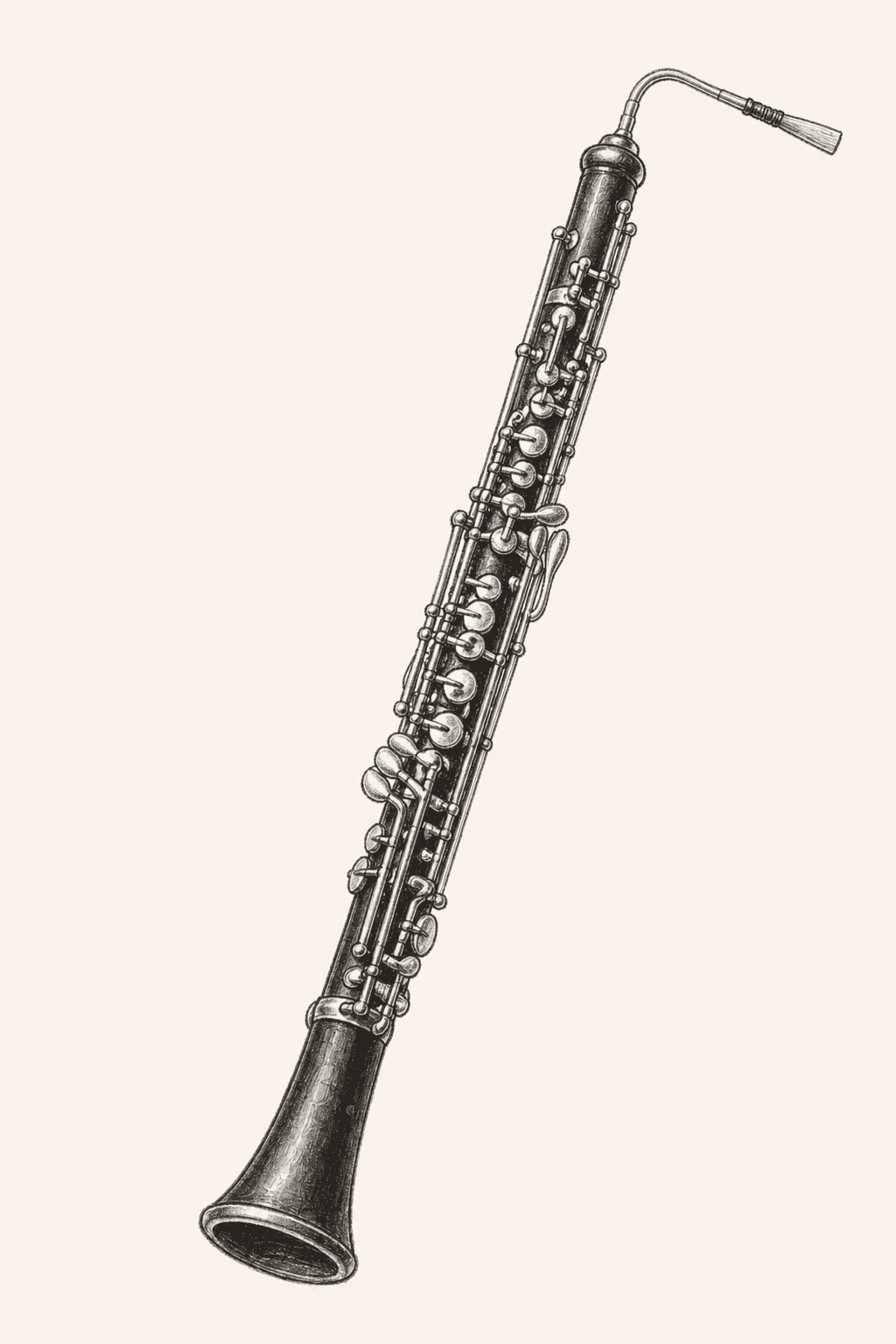
The bore is conical, the reed double, and the bell — closed to a gentle pear — gives the instrument the muffled, inward sound by which it is known.
The cor anglais is the orchestra’s great mourner. A fifth below the oboe, with a wider bore and a closed pear-shaped bell, it speaks in a voice that the oboe cannot quite reach — darker, slower to ignite, and more inward. Composers have always understood this. From the shepherd of Tristan to the Largo of the New World, the instrument is summoned when a melody needs the weight of memory upon it.
It is, in effect, an alto oboe — the same fingerings, the same embouchure, the same family of reeds. Most orchestral oboists double on it. But the family resemblance can mislead. The cor anglais is not merely a transposed oboe; it is a different instrument with its own gravities, and writing for it as a low oboe is the surest way to misuse it.
Mechanism
The body is grenadilla, in two joints, stained almost black. The reed is double, slightly larger than an oboe’s, and is mounted not on a staple driven into the wood but on a slim curved metal tube — the bocal or crook — which lifts it to the lips at a natural angle. At the lower end the bell flares not outward but inward, into a closed pear shape called the Liebesfuß: the same bell that gave the older oboe d’amore its name and that gives the cor anglais much of its veiled tone.
The keywork is, in essentials, that of the modern conservatoire oboe — the same Boehm-influenced system perfected by the Triébert workshop and then by Lorée. The instrument therefore poses no fingering puzzle to the player who knows its smaller cousin. What changes is the air, and the patience required of it.
Voice and Character
Berlioz, in his Treatise, called the tone of the cor anglais “melancholy, dreamy, and rather noble — a kind of distant echo, the voice of a bygone age.” It has not since been improved upon as a description. The instrument carries within it a faint air of pastoral — the shepherd’s pipe, the ranz des vaches — and composers have rarely tried to argue with that inheritance.
The middle and lower registers are where it lives. There the sound is warm, slightly nasal, candid; the player can shape a long phrase with the directness of a singer. The upper register exists, and is used, but with care: above the staff the tone narrows, the reed strains, and the instrument begins to lose what made it itself in the first place.
“Melancholy, dreamy, and rather noble — a kind of distant echo, the voice of a bygone age.”
— Hector Berlioz, Treatise on Instrumentation
Use the instrument when the music wants for inwardness. It will repay any composer who treats it as a soloist first and a member of the choir second.
The bore is conical, the reed double, and the bell — closed to a gentle pear — gives the instrument the muffled, inward sound by which it is known.
Most players come to the cor anglais from the oboe. Write for it as though for that other instrument, but a slower, graver one — and a few habits will serve you well.
- i.Notate in F. Write a perfect fifth above the sounding pitch, in treble clef. The instrument has been written so since Wagner, and the player expects nothing else.
- ii.Live in the middle. Most of the great solos lie between written E₄ and E₅. Stay there for the singing material; venture above and below for colour, not for distance.
- iii.Allow the doubler to change. A second oboist switching to cor anglais needs eight to ten bars of rest, and a moment to settle the reed. Build the change into the music, not against it.
- iv.Spare the highest fifth. Above written A₅ the tone hardens and the instrument’s particular grace is lost. If you must climb that high, climb briefly.
- v.Trust the silence around it. The cor anglais is heard best out of texture, not within it. Thin the accompaniment to a held chord or a pizzicato pulse, and the solo will carry by itself.
For all else, write as you would for the oboe — and then ask the player. Cor anglais soloists are, almost without exception, generous teachers of their own instrument.
The full compass (written)
B₃ to A₅ — sounding E₃ to D₅, a perfect fifth lower.
The compass extends from the low B₃ — written, sounding E₃ — to a written A₅ in good hands, with rare ascents to written C₆ in modern repertoire. Four regions repay study, and all are notated in treble clef.
Basso
The lowest fourth — reedy, plaintive, and slow to speak. Sustains better than it leaps. The shepherd of Tristan lives here, as does the doleful opening of the Largo.
Tenore
The singing voice. Warm, candid, faintly nasal. The register of nearly every great solo — Dvořák, Sibelius, Berlioz, Franck. If a melody is to be remembered, it is most often remembered from here.
Acuto
The instrument leans forward and grows more pointed. A useful colour for plaintive lines and high pastoral writing — but the closer the music draws to ordinary oboe territory, the more it forfeits.
Sopracuto
The instrument’s ceiling under most conditions. Thin, strained, and reserved for moments of expressive necessity. Higher pitches exist on certain modern instruments, but lie outside the music a player can be asked to give.
The bore is conical, the reed double, and the bell — closed to a gentle pear — gives the instrument the muffled, inward sound by which it is known.
The cor anglais is, in technical inheritance, an oboe; in temperament, something graver and more reluctant. Its expressive vocabulary is therefore the oboe’s, used at a slower pace and with a different sense of what is worth saying. The instrument rewards restraint above almost everything else: the player who tries to treat it as a vehicle for display will misuse it, and the composer who does the same will write past it.
Standard techniques
Articulation is single-tongued in essentially all orchestral writing — the reed’s response is so immediate, and the demands of the long sustained line so central, that double tonguing has never become standard practice. The repertoire is, by inclination, a repertoire of slurred legato. From the shepherd of Tristanto the Largo of the New World, the great solos move by breath and by phrase, not by the tongue, and the player’s first responsibility is to shape the long line.
Vibrato is used, but with a reserve that distinguishes the instrument from its smaller cousin. Where the oboe vibrato is often bright and forward, the cor anglais’s is slower and narrower, and in some traditions — the French in particular — applied with marked moderation. Dynamic control is fine in the middle register and more constrained at the extremes; the lowest fourth wants air, and the highest fifth pinches the reed. Breath economy is the single technical preoccupation of the instrument: the long unbroken phrase is its inheritance, and the player learns early to find rest within the line rather than after it.
Extended techniques
The contemporary repertoire has begun to draw on the wider oboe-family vocabulary, though more sparingly than for the oboe proper. Multiphonics are available — the instrument’s wider bore yields a darker, more resonant set of multiple-pitch sonorities than the oboe — and microtones can be obtained by alternate fingerings and embouchure adjustment. Glissando is not a true glide, the keywork being conventional, but small embouchure-driven bends and chromatic smears are within reach.
Flutter-tongue is possible but rarer than on the flute or clarinet, and tends to suit the lower and middle registers; the higher one climbs, the more the reed resists the effect. Harmonics can be drawn from the lower fingerings by overblowing, useful chiefly as a colour. Circular breathingis practised by some players and is a powerful resource for the very long sustained line, though it should never be assumed; ask, and write a discreet alternative if the music depends upon it. Above all, the cor anglais is heard best when not asked for too much. Its great gift is candour, and candour is what most extended techniques tend to displace.
The bore is conical, the reed double, and the bell — closed to a gentle pear — gives the instrument the muffled, inward sound by which it is known.
Five passages — a beginning, not a survey — by which to know what the cor anglais has been asked to do, and what it has consented to give.
- № 01
Dvořák — Symphony No. 9, From the New World
Largo
The most famous cor anglais solo ever written — a melody so settled it has been mistaken, more than once, for a folk tune older than itself.
Listen on Spotify - № 02
Sibelius — The Swan of Tuonela
Lento
The instrument as the swan itself, gliding on the river of the dead. Almost the entire tone-poem is given to it.
Listen on Spotify - № 03
Wagner — Tristan und Isolde
Act III, opening — the shepherd’s lament
A solo of more than two minutes, alone behind the curtain — Wagner’s clearest portrait of grief without a witness.
Listen on Spotify - № 04
Berlioz — Le Carnaval romain
Andante sostenuto
A love song lifted from the unfinished Benvenuto Cellini — wide, unhurried, taking the long way home.
Listen on Spotify - № 05
Rossini — Guillaume Tell
Overture, Ranz des vaches
A pastoral dialogue with the flute, set above bare strings — the Alps in two reeds and a bow.
Listen on Spotify
Further entries will be added as our study deepens.
The bore is conical, the reed double, and the bell — closed to a gentle pear — gives the instrument the muffled, inward sound by which it is known.
The cor anglais traces its descent to the oboe da caccia — the curved hunting oboe of the early eighteenth century, for which Bach wrote some of the most affecting obbligato lines in the Passions. From its bent body and pear-shaped bell came the silhouette and the sound that the modern instrument still preserves.
The eighteenth century
The first instruments recognisable as cor anglais — straight-bored or gently angled, with a closed Liebesfuß bell — appeared in Silesia and Vienna around 1750. The name itself is a small mystery. Neither English nor a horn, the instrument is sometimes said to derive its French name from the older cor anglé (angled horn); the explanation is plausible, contested, and now beyond settling.
Wagner and the modern voice
Wagner’s Act III shepherd in Tristan und Isolde, in 1865, is the moment at which the cor anglais became fully itself. Two minutes of unaccompanied solo — the longest of its kind in the orchestral repertoire — settled both the instrument’s expressive territory and the manner in which composers would, ever after, deploy it: alone, at a distance, marked the burden of a remembered grief.
Lorée and the conservatoire instrument
In Paris, F. Lorée — heir to the Triébert workshop — produced toward the end of the nineteenth century the cor anglais of the modern conservatoire system: even in scale, accurate in pitch, and at last the unambiguous equal of its smaller cousin. The Lorée pattern remains, with refinements, the instrument played in nearly every professional orchestra today.
The modern instrument
The cor anglais of the present is, in essence, the late-Romantic instrument with quieter keywork and steadier intonation. It is the one Sibelius wrote for in The Swan of Tuonela, the one Shostakovich wrote for in his symphonies, the one Copland called upon in Quiet City. Its repertoire grows still, but slowly: the instrument is rarely written for casually, and that, perhaps, is part of why it has aged so well.
Specifications
A summary, for the composer’s desk.
- Family
- Woodwind, double reed
- Italian
- Corno inglese
- German
- Englischhorn
- French
- Cor anglais
- Range
- Written B₃ — A₅; sounding E₃ — D₅
- Transposition
- In F — sounds a perfect fifth below the written pitch; treble clef
- Length
- Approx. 81 cm (32″)
- Bore
- Conical, of grenadilla; pear-shaped bell (Liebesfuß)
- Reed
- Double, of Arundo donax, mounted on a curved metal bocal
- Origin
- Silesia, mid-18th century