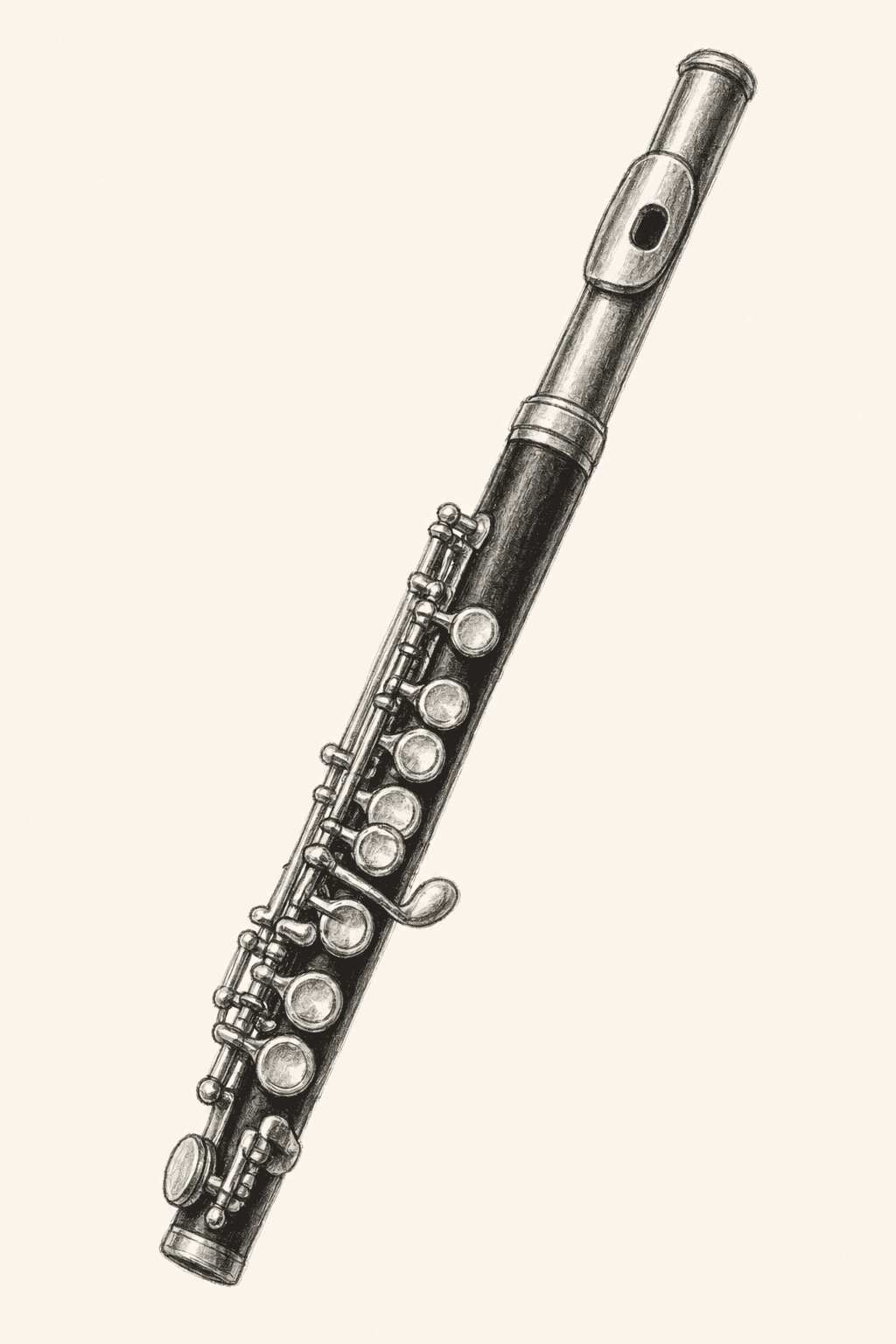
A short conical tube, scarcely a foot long — held transverse, like its larger sister, and blown across the lip plate of the headjoint.
The piccolo is the flute writ small — half the length, an octave higher, and possessed of a character all its own. It is brilliant without effort, shrill if asked too much, and capable, in its middle register, of a sweetness no other woodwind can quite match. Composers either love it dearly or use it sparingly; rarely both.
It is, before anything else, an instrument of the top. A single piccolo will be heard above ninety musicians at full cry — a fact every orchestrator learns once, and afterwards never forgets. Its powers should be saved, like fireworks, for the moments that warrant them: storms, marches, the final pages of symphonies and the first light of ballets.
Mechanism
The piccolo is built in two principal joints — headjoint and body — most often of grenadilla or cocus, sometimes of silver, and occasionally of a wood body fitted with a metal headjoint. The keywork follows the Boehm system, identical in fingering to the modern flute, though the bore is conical where the flute’s is cylindrical, and narrows steadily toward the foot.
Sound is produced as it is on the flute — by the player’s breath striking the far edge of the embouchure hole — but everything is smaller, faster, and more demanding of intonation. A flautist does not simply pick up the piccolo and play; the embouchure is its own discipline, and the best piccolo players are those who practise the two instruments as kin, not as one.
Voice and Character
Berlioz, in his Treatise, returns again and again to the piccolo with a mixture of admiration and warning. In the high register it is, he writes, “excellently fitted to express violent passions and the strident accents of fury and vengeance,” and yet equally capable, with care, of the most delicate effects. The instrument is a creature of contrasts. It is the lightning of the orchestra and, when held back, also its most fragile thread.
Its low register is breathy and weak, almost a whisper; the middle is round and pure, the most underused part of the instrument; the upper, brilliant; and the extreme top, piercing — a sound that no forte in the strings can cover. The composer who knows when to deploy each is the composer the piccolo will reward.
“In the high register it is excellently fitted to express violent passions, and the strident accents of fury and vengeance.”
— Berlioz, Grand traité d’instrumentation
The piccolo asks little, and gives much — provided the writer remembers that, of all the orchestra’s voices, this is the one most easily made to scream. Use it well and it will sing. Use it badly and it will not be forgiven.
A short conical tube, scarcely a foot long — held transverse, like its larger sister, and blown across the lip plate of the headjoint.
The piccolo will reward the composer who treats it as a soloist even when it is not, and punish the composer who treats it as a decoration always. A few habits, kept in mind, will help.
- i.Write at sounding pitch only when you must. The piccolo reads in treble clef, sounding an octave higher; written above the staff is the rule, and ledger-line forests are the consequence of forgetting it.
- ii.Beware the lowest fifth. From D₄ to A₄ the tone is breathy and indistinct; covered by anything at all, it disappears. Reserve those notes for exposed lines, or do not write them.
- iii.Honour the middle register. Between G₅ and G₆ written — the second octave — the piccolo is sweetest. Most composers ignore it; it is the surest source of new colour the instrument offers.
- iv.The top is loud, always. Above C₆ written, the piccolo cannot truly play piano — and above G₆ it cannot play less than forte. Plan dynamics around the player, not against them.
- v.Give the player rests, and a moment to breathe. The instrument is exhausting at the top of its range. A piccolo line without silences is a piccolo line a player will come to dread.
Beyond these few rules, write with the player in mind. A piccoloist will tell you what is possible — and, more usefully, what is beautiful.
The full compass (written)
D₄ to C₇ written — sounding D₅ to C₈, three octaves.
The compass extends from D₄ — the same lowest note as its larger sister, the flute — up to C₇ in skilled hands, and a tone or two beyond in extremity. All notes sound an octave higher than written. Four regions repay study.
Grave
Breathy, weak, almost flute-like in its hesitation. It will not carry over a tutti and barely over a piano accompaniment. Use it exposed, or not at all.
Medio
The instrument’s most underused octave. Sweet, round, and curiously gentle — closer in colour to the flute than most listeners would credit. The register in which the piccolo most resembles a singer.
Acuto
Brilliant, focused, and incapable of anything quieter than mezzo-forte. The natural home of the piccolo — bright marches, storm music, the upper line of any tutti needing edge.
Sopracuto
The shrieking summit. Piercing and ungovernable in dynamic, the highest sustained pitches in the orchestra. Reserve it for moments the music has truly earned.
A short conical tube, scarcely a foot long — held transverse, like its larger sister, and blown across the lip plate of the headjoint.
The piccolo, smaller and more recalcitrant than the flute, accepts most of its larger sister’s expressive vocabulary — and excels at a few effects of its own. The instrument’s natural brilliance turns ornament into incident: a trill on the piccolo is a small event in the orchestra, and a flutter-tongue, an unmistakable one.
Standard techniques
Articulation on the piccolo is, if anything, sharper than on the flute. Single tonguing answers up to remarkable speeds; double and triple tonguing render the rapid passagework that has been the instrument’s stock-in-trade since Vivaldi. Trills are brilliant and carrying, the piccolo’s first ornament; the instrument has always supplied storms and martial flourishes with them. Slurred writing is possible across the whole compass, though wide leaps in the upper register demand a precision of embouchure that no fingering will provide.
Vibrato, as on the flute, is a matter of throat and diaphragm; piccoloists tend to use it more sparingly, since the instrument’s upper register can be made to sound nervous by too much of it. Dynamics are the perennial difficulty: a true piano above the staff is essentially out of reach, and a true forte in the lowest fifth is barely audible. Most of the instrument’s expressive subtlety lives, paradoxically, in the unfashionable middle register.
Extended techniques
Flutter-tongue is the piccolo’s most striking modern effect — and, because of the instrument’s carrying power, perhaps the most readily orchestral of all. Mahler used it; Shostakovich used it; the storms of countless twentieth-century scores rely on it. Key clicks are audible but slighter than on the flute, the smaller pads producing a tighter, drier snap. Pitch bending by embouchure is freely available within a quarter-tone or so, and is the basis of the small glissandi the instrument can manage; true sweeping glissandi, of the sort one hears on the flute, are not idiomatic and rarely well written.
Harmonics are technically possible — overblown from a fingered fundamental — but rarely useful: the piccolo is already thin enough at its top, and the harmonic colour adds little. Multiphonics exist, are difficult, and produce a faintly animal sound that a few modern composers have used to telling effect. Microtones can be drawn from altered fingerings; singing while playing and circular breathing are within reach of trained players, though both are uncommon in orchestral writing. The piccolo is at its most modern when it sounds, briefly, like a thing other than itself — and at its most eloquent when it does not.
A short conical tube, scarcely a foot long — held transverse, like its larger sister, and blown across the lip plate of the headjoint.
A short, partial list — five places to begin if one wishes to know what the piccolo can do, and what composers from Beethoven onward have asked it to do.
- № 01
Beethoven — Symphony No. 5, Finale
Allegro
Its admission to the orchestra. The piccolo enters with the trombones and contrabassoon, and the symphony breaks into daylight.
Listen on Spotify - № 02
Vivaldi — Concerto in C major, RV 443
Allegro
Written for the flautino — its modern home is the piccolo. Cascades of semiquavers, brilliant and unrelenting.
Listen on Spotify - № 03
Tchaikovsky — Symphony No. 4
Third movement, trio
A miniature march for the woodwinds, the piccolo skipping above on its toes — pizzicato strings beneath, like distant tambourines.
Listen on Spotify - № 04
Sousa — The Stars and Stripes Forever
Final trio
The most famous piccolo obbligato in any repertoire — once heard, never quite shaken loose.
Listen on Spotify - № 05
Shostakovich — Symphony No. 9
First movement
A glittering, faintly mocking solo above the strings — the piccolo as a small bright bird the composer cannot quite take seriously.
Listen on Spotify
Further entries will be added as our study deepens.
A short conical tube, scarcely a foot long — held transverse, like its larger sister, and blown across the lip plate of the headjoint.
The piccolo descends from the fife — a small, keyless transverse flute that for centuries marched alongside the snare drum in the regiments of Europe. The military fife is not, strictly, the piccolo; but the kinship is plain in every shrill march and storm passage that followed.
The fife and the flautino
Vivaldi, in the early eighteenth century, wrote three concertos for what he called the flautino — a small, high-pitched flute whose precise identity scholars still debate. Whatever the original instrument, those concertos are now standard piccolo repertoire, and no piccoloist of any seriousness has not played them.
Beethoven and the orchestra
The piccolo entered the symphony orchestra by the side door, with Beethoven’s Fifth Symphony of 1808. Its first appearance in the finale — alongside the contrabassoon and three trombones, all making their orchestral debut at once — is one of the great instrumentation moments in the repertoire. Beethoven used it again in the storm of the Sixth, and the precedent was set: the piccolo is the orchestra’s lightning, kept for the moments when lightning is wanted.
The Boehm reform
Theobald Boehm’s redesign of the flute’s keywork in the mid nineteenth century carried over, in time, to the piccolo. The instrument acquired a full set of Boehm-system keys, the conical bore was refined, and the modern wood-bodied piccolo emerged — an instrument capable of playing in tune across its full compass, a thing its predecessors could not reliably claim.
The modern instrument
The piccolo of the twenty-first-century orchestra is essentially the late-nineteenth-century instrument, refined in keywork and materials but otherwise settled. Most professional players prefer a wooden body — usually grenadilla — for the warmth it lends the middle register; metal piccolos persist in marching bands, where weather is unkind to wood. Otherwise, what Tchaikovsky and Mahler wrote for is what a player picks up today.
Specifications
A summary, for the composer’s desk.
- Family
- Woodwind, transverse flute
- Italian
- Ottavino
- German
- Kleine Flöte
- French
- Petite flûte
- Range
- D₄ — C₇ (written); D₅ — C₈ (sounding)
- Transposition
- Sounds one octave higher than written; treble clef
- Length
- Approx. 32 cm (12½″)
- Bore
- Conical, narrowing toward the foot
- Material
- Grenadilla or cocus wood; sometimes silver
- Origin
- Europe, late 18th century