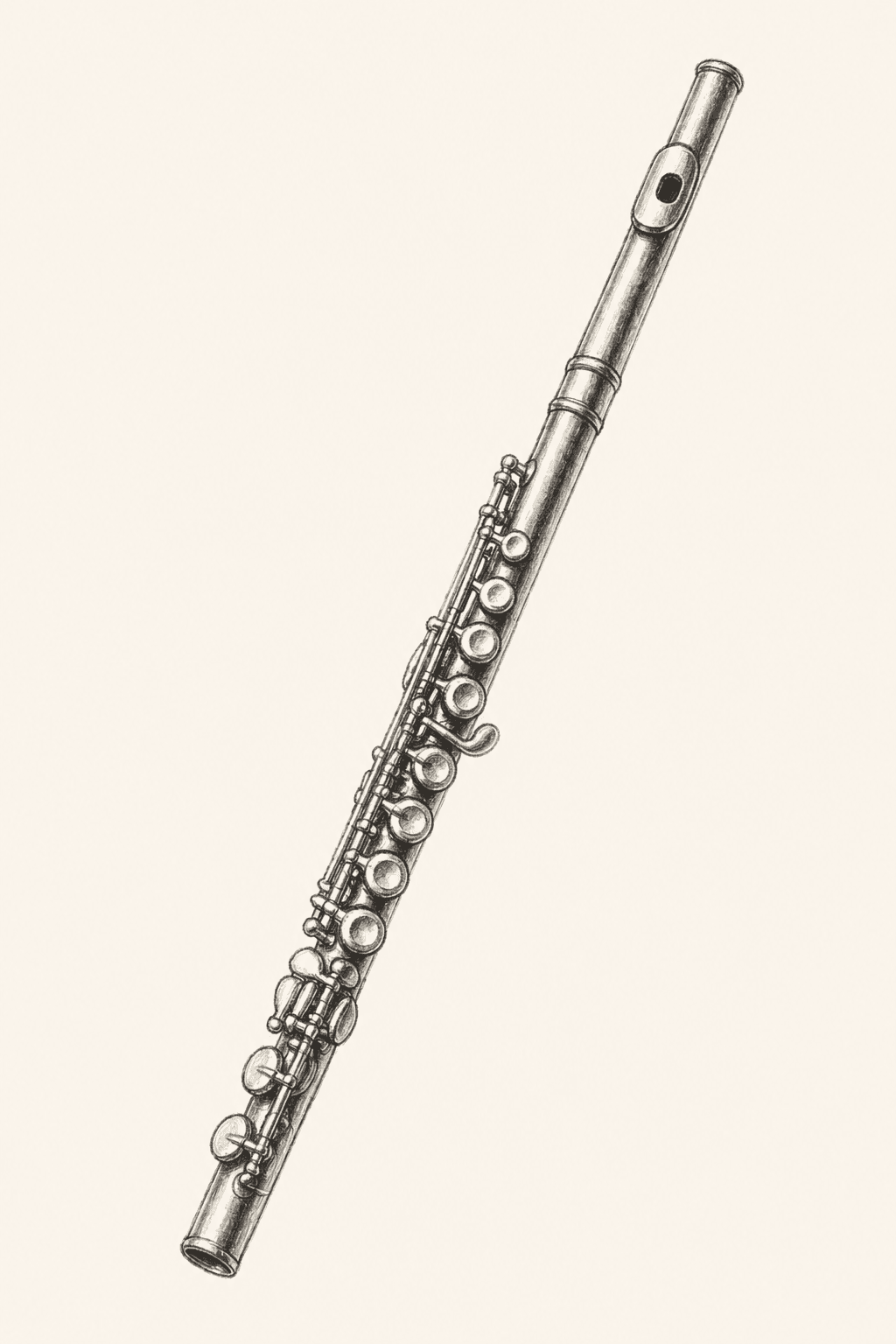
A cylindrical tube of some two feet — held sideways, voiced by breath alone across the lip plate.
Of all the orchestra’s woodwinds, the flute is the least encumbered — no reed between the player and the air, only the lip and the edge of the embouchure hole. From this simplicity arises the instrument’s whole character: clarity, agility, and a coolness of tone that has, for two centuries, given composers their image of pastoral, of dawn, of birds.
It is an instrument of breath above all else. The lowest octave is velvety, almost husky; the middle round and singing; the upper bright and penetrating, capable of cutting through a full orchestra without apparent effort. Between these regions the flautist moves with an ease no other wind player enjoys — but the cost is a constant, considerable expense of air.
Mechanism
The modern flute is built of three joints — head, body, and foot — most commonly of silver, sometimes of gold or grenadilla. The body is a cylindrical tube; the head joint, more subtle, tapers in a parabolic curve toward the cork. Air strikes the far edge of the embouchure hole and splits into the column below, setting it vibrating — a mechanism the Greeks already understood, and the centuries since have only refined.
The keywork is the Boehm system, devised by Theobald Boehm in Munich in 1847 and adopted, with remarkable speed, almost everywhere. It places the tone-holes where acoustics demand rather than where fingers fall, and uses rings, levers, and rods to bring those holes within reach. The flautist of the present plays an instrument substantially as Boehm left it.
Voice and Character
Berlioz, attentive as ever, observed that the flute is a voice “of singular character, susceptible of expressing many shades of feeling — sadness, tenderness, but also brilliance and even fury.” He thought it suited above all to scenes of antiquity, of moonlight, of pastoral repose; the nineteenth century wrote almost nothing for it that contradicts him. A flute solo at the right moment will draw the room toward stillness more reliably than any other instrument.
And yet the flute is also the orchestra’s sprinter. The Badinerie of Bach, the cadenzas of Mozart, the perpetual-motion finales of Vivaldi — all rest on its capacity for rapid, perfectly even articulation. To write for the flute is to choose, in each phrase, between the singer and the runner. The instrument will be, faithfully, whichever you ask.
“The flute is not a wind instrument — it is the wind itself, lent a shape for the duration of a phrase.”
— paraphrased, after a remark in the studio
Among the woodwinds the flute is the eldest by ancestry and the youngest by mechanism. Write for it without prejudice, and it will surprise you twice — once with what it can do, and once with how little of itself it seems to spend doing it.
A cylindrical tube of some two feet — held sideways, voiced by breath alone across the lip plate.
The flute is generous, but it is not infinite. A few practical habits will return the favour and spare the player a great deal of grief at the desk.
- i.Account for the breath. The flute is the most air-hungry instrument in the woodwind section. Long phrases are possible, but so are choking flautists; build a place to breathe.
- ii.Beware the low register against tutti. The lowest octave is beautiful, but quiet — and easily covered. Reserve it for thin textures, or double it when scoring against weight.
- iii.Trust the agility, but justify it. The flute will play almost anything you write. That is precisely why one must take care: brilliant passagework without melodic purpose tires the listener faster than the player.
- iv.Use the upper register sparingly. Above the staff the flute carries effortlessly — and tirelessly, to the audience’s ears. Climb there when the music has earned the climb.
- v.Pair it carefully. With clarinet for warmth, with oboe for plaintiveness, with piccolo for brilliance at the octave. The flute blends with almost anything; the question is what you wish to colour.
Beyond these few rules, write with the player in mind. A flautist will tell you what is possible — and, more usefully, what is beautiful.
The full compass
C₄ to C₇ — three octaves, with a low B available on flutes fitted with the B-foot.
The compass extends from middle C₄ — or, on instruments with the longer foot joint, from B₃ — to a high C₇ in any flautist’s hands, and a tone or two beyond on request. Four regions repay study.
Grave
Velvety, almost husky — the flute at its most private. Easily covered by the orchestra; reserve for thin textures, solo writing, or careful doubling. A whispered colour, not a projecting one.
Medio
The singing voice of the instrument. Round, full, even at any dynamic — the home of nearly every great flute solo. Carries against most accompaniments without strain.
Acuto
Bright and penetrating; the register that cuts through tutti without apparent effort. Brilliant in passagework, plaintive when held — Ravel and Debussy live here.
Sopracuto
Piercing, almost whistled. Demands precision of embouchure and a tolerance from the listener; reserve it for moments the music has earned, and never lay a delicate phrase here.
A cylindrical tube of some two feet — held sideways, voiced by breath alone across the lip plate.
The flute, lent only the player’s breath, possesses an expressive vocabulary as wide as any in the orchestra. From the cleanest legato to the strangest of modern colours, almost every sound the instrument has ever produced remains available — and almost every modern flautist has, at some point in training, attempted them all.
Standard techniques
Articulation is the flute’s native virtue. Single tonguing answers for most music; double and triple tonguing — the familiar tu-ku and tu-tu-ku — render rapid passagework cleanly at any tempo a composer is likely to ask. The Badinerie of Bach and the finales of Vivaldi rest upon this fluency. Staccato is light and exact; legato, conducted by breath rather than tongue, will join almost any interval the lungs can sustain.
Vibrato on the modern flute is produced in the throat and diaphragm rather than at the lip, and is, by twentieth-century custom, almost continuous in lyrical writing — though its breadth and speed remain at the player’s discretion. Dynamics are the flute’s oldest negotiation: pianissimo in the upper register requires a delicacy of embouchure that approaches the acrobatic, while a true forte in the lowest octave is, frankly, the loudest the instrument can ever be asked to play. Ask thoughtfully and one will be granted.
Extended techniques
The twentieth century opened the flute to a catalogue of effects so large that whole compositions — Berio’s Sequenza I, Varèse’s Density 21.5, the works of Takemitsu and Ferneyhough — turn almost entirely upon them. Flutter-tongue, a rolled r sustained against the airstream, gives a granular, shivering tone that Strauss and Mahler had already discovered. Harmonics, overblown from a fingered fundamental, sound thinner and more glassy than the natural note — Ravel and Debussy both knew the trick.
Multiphonics, produced by partial fingerings and a divided airstream, yield two or three pitches at once, often quietly unstable; microtones, by altered fingerings or partial keys, place quarter-tones and smaller intervals within the player’s reach. Key clicks — the percussive snap of pads against tone-holes, with or without breath — give a faintly tuned percussion at the foot of the instrument. The jet whistle, a violent gust forced across the embouchure, produces a high glissando rush; the tongue ram, a sudden stoppage of the airstream against the lip-plate, sounds a pitch nearly a major seventh below the fingering.
Quieter still are whistle tones — the faintest harmonic partials, voiced almost without breath — and the aeolian or breath-only sound, all wind and no pitch. Singing while playing produces a rough, two-voiced texture beloved of jazz flautists and more than one modernist; circular breathing, increasingly common in advanced players, allows phrases of theoretically unlimited length. None of these belongs to the flute by birthright, but each has, by a century of use, become part of its expressive estate.
A cylindrical tube of some two feet — held sideways, voiced by breath alone across the lip plate.
A short, partial list — five places to begin if one wishes to know what the flute can do, and what it has been asked to do by composers who loved it.
- № 01
Debussy — Prélude à l’après-midi d’un faune
Opening solo
A descending chromatic line out of stillness — the moment, by common consent, at which modern music begins.
Listen on Spotify - № 02
Bach — Suite No. 2 in B minor, BWV 1067
Badinerie
The instrument as quicksilver. Two minutes of perpetual motion, and a test of every flautist’s tongue.
Listen on Spotify - № 03
Ravel — Daphnis et Chloé, Suite No. 2
Pantomime
A long, unhurried solo above the orchestra — the flute as Pan, calling across a clearing in the morning light.
Listen on Spotify - № 04
Prokofiev — Peter and the Wolf
The Bird
A small, bright character drawn in two phrases. Children remember it for life; so do most flautists.
Listen on Spotify - № 05
Brahms — Symphony No. 4
Fourth movement, variation 12
A solo of marked sadness, set within the great passacaglia — the flute alone, descending against the unmoved bass.
Listen on Spotify
Further entries will be added as our study deepens.
A cylindrical tube of some two feet — held sideways, voiced by breath alone across the lip plate.
The flute is, by ancestry, the oldest instrument the orchestra knows. Bone flutes survive from forty thousand years ago; transverse flutes of bamboo and wood are older than recorded music in nearly every culture. The instrument we know today is the European refinement of an idea that humanity discovered before it discovered metal.
The Baroque
By the early eighteenth century the transverse flute, or traverso, had taken its place in the orchestra alongside the recorder it was steadily displacing. Its bore was conical, its body of boxwood or grenadilla, its keywork limited — usually to a single key for D♯. Bach wrote sonatas and obbligatos for it; Telemann and Quantz wrote a great deal more. The instrument of this period was softer, breathier, and more variable in tuning than its modern descendant.
Mozart and the classical voice
Mozart professed to dislike the flute, and wrote two concertos and a quartet for it anyway, all of them masterworks. By his time the instrument had acquired four to six keys and was settled in the Classical orchestra in pairs. It was still a wooden instrument, still gentle of voice, still, in its own way, an heirloom of the Baroque — but it was unmistakably a soloist.
Boehm and the silver flute
In 1832, and again, decisively, in 1847, the Munich flautist and goldsmith Theobald Boehm rebuilt the instrument from the bore outward. He replaced the conical bore with a cylinder, the parabolic head joint with one tuned by acoustic principle, and the small finger-holes with large holes placed where the air column required them — joined by a ring-and-axle keywork that made the unreachable reachable. Within a generation the wooden flute was a survivor, not the standard. The silver Boehm flute was the modern instrument.
The modern instrument
The flute that Debussy heard for Prélude à l’après-midi d’un faune in 1894 is, in essence, the flute the player picks up today. Twentieth-century refinements — the gold lip plate, the offset G key, the open-hole French model — are matters of taste and fine adjustment. The instrument itself, like the bassoon, has achieved a quietly settled craft.
Specifications
A summary, for the composer’s desk.
- Family
- Woodwind, transverse flute
- Italian
- Flauto
- German
- Flöte (Querflöte)
- French
- Flûte (flûte traversière)
- Range
- C₄ — C₇ (B₃ with the B-foot)
- Transposition
- Non-transposing; treble clef
- Length
- Approx. 67 cm (26½″)
- Bore
- Cylindrical body, parabolic head joint
- Material
- Silver, gold, or grenadilla wood
- Origin
- Europe; modern form, Munich, 1847