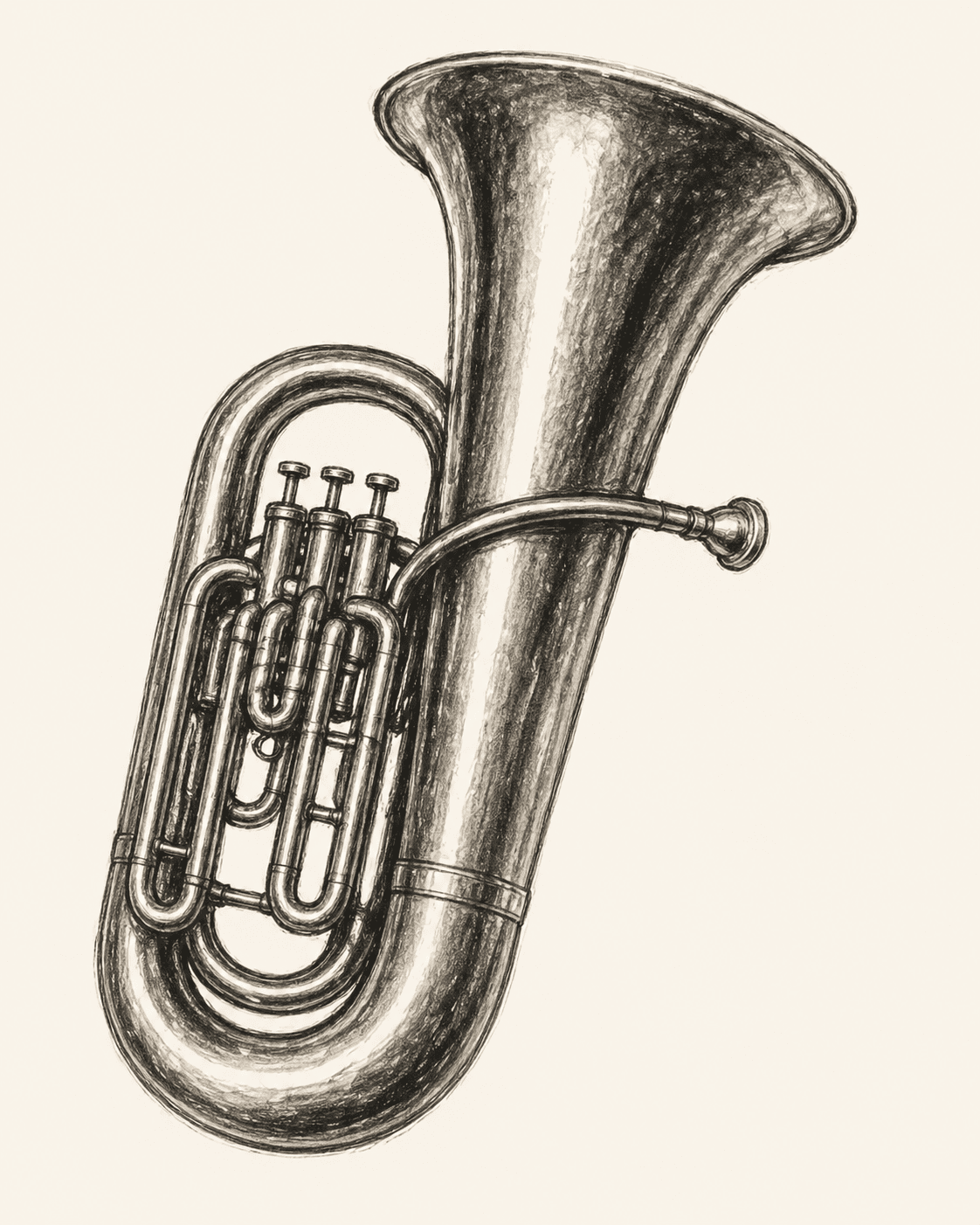
A wide conical bore of some eighteen feet, coiled twice upon itself — its weight rested on the player’s lap or borne by a strap.
The tuba is the foundation upon which the brass choir stands. Its bore is wide and conical, its mouthpiece a deep cup, and its sound — at full breath — has the weight of a small organ pedal stop. Yet for all its gravity it is a young instrument: scarcely two centuries old, the last of the orchestra’s brass to find its place, and still — to the alert ear — the most surprising of them.
It exists in several keys and several sizes. The orchestral player will most often use a contrabass instrument in C or B♭; the soloist and the chamber player will sometimes prefer a smaller F or E♭ tuba, nimbler in the upper register and lighter on the breath. To the composer the differences are largely invisible. Write well for the tuba and any of its sizes will answer.
Mechanism
The tuba is a single conical tube, coiled twice or three times, with a wide flaring bell. Air enters at the mouthpiece — a deep funnel of brass or silver — and is set vibrating by the player’s lips. The valves, three to six in number and either piston or rotary, divert the air through additional lengths of tubing, lowering the fundamental and so completing the chromatic compass. The fourth and fifth valves, when present, exist chiefly to correct the tuning of the lowest notes, and to extend the range downward into the pedal.
Construction is, in essentials, simple: a leadpipe, a set of valves, and a long expanding bore that ends at the bell. What separates the instruments is proportion. The American CC tuba speaks crisply and favours the orchestra; the German rotary BB♭ blooms more slowly and sits deeper in the section. A composer writing for tuba writes, in practice, for the tradition of the orchestra in question.
Voice and Character
Berlioz, who was the first major composer to take the new instrument seriously, found in it a tone “incomparably nobler than that of the ophicleides, serpents, and bombardons” it had begun to replace. He understood, very early, that the tuba was not merely a louder bass — it was a different kind of bass, capable of sustaining a line as a singer would, and of disappearing into the ensemble when asked.
The tuba is, by gentle accident, also the orchestra’s most lyrical giant. Mussorgsky’s Bydło, in Ravel’s orchestration, is sung rather than played; Vaughan Williams gave the instrument an entire concerto on the assumption that it could carry a Romanza without embarrassment. The assumption was correct. Honor it. The tuba is no longer the punchline it was once taken to be.
“The tuba is the contrabass of the brass — and, like all contrabasses, contains more soul than weight.”
— paraphrased from the orchestration treatises
The tuba is, of all the brass, the most willing to be reinvented. Write for it as a foundation, as a soloist, as a comedian, as a consoler — it has played all four roles already, and will play them again.
A wide conical bore of some eighteen feet, coiled twice upon itself — its weight rested on the player’s lap or borne by a strap.
The tuba rewards generosity in the breath and parsimony in the note. A handful of habits, kept in mind, will save many later revisions.
- i.Give the player air. The instrument consumes more breath than any other in the orchestra; long phrases without rests are not phrases but hardships.
- ii.Anchor the brass, but do not double them blindly. A tuba an octave below the trombones will steady the section; a tuba in unison with them will only thicken it.
- iii.Trust the upper register. From middle B♭ to top F the tuba sings as plainly as a euphonium — many of its finest solos sit there, not in the cellar.
- iv.Write in bass clef. Always — even at the top. The orchestral player reads no other clef, and treble-clef parts belong to the band tradition.
- v.Mind the speed of low notes. The lowest octave speaks slowly and demands generous note values; rapid figures below the staff will blur into a hum.
Beyond these few rules, write with the player in mind. A tubist will tell you what is possible — and, more usefully, what is beautiful.
The full compass
F₀ to F₄ — four octaves, with pedal extension below.
The compass extends from the deep pedal F₀ — a note felt as much as heard — up through a working F₄ in skilled hands. Four regions repay study, though the boundaries between them are gentle ones.
Pedale
The fundamental tones — slow to speak, immense in body, and used by composers chiefly for atmosphere or as the literal floor of a chord. Wagner adored them; most composers use them sparingly, and well.
Basso
The working low register — solid, broad, the bass of the orchestra at full tutti. Rapid passagework here is heavy going; held notes and slow-moving lines are where the register sings.
Tenore
The singing register, and the home of the instrument’s great solos. Direct, warm, faintly woody — the tuba most resembles a baritone here, and most composers find their best lyrical writing in this octave.
Acuto
The high register — bright, slightly pinched, and entirely playable in skilled hands, though it asks for control of the embouchure. Reserve it for moments the music has earned.
A wide conical bore of some eighteen feet, coiled twice upon itself — its weight rested on the player’s lap or borne by a strap.
The tuba is younger than its neighbours in the brass, and its technical vocabulary has been shaped, over barely two centuries, by players who have insisted, gently and repeatedly, that the instrument is capable of more than the foundation it was first asked to provide. The modern player is, in fact, a soloist in waiting — and the writing has begun, at last, to catch up.
Standard techniques
Single tonguing is the tuba’s primary articulation, and at the instrument’s ordinary tempi it is sufficient. Double tonguing — and, in skilled hands, triple — has nonetheless become a regular part of the professional kit, opening passagework that the bore would once have refused. Lip slurs across the harmonic series are idiomatic and beautifully smooth; the instrument’s wide bore makes them easier than one might expect, and the modern player covers intervals on the slur that earlier generations would have tongued.
The dynamic compass is enormous — from a barely audible pianissimo to a fortissimo that can underpin the entire orchestra — and the agility of a good principal is, to the unfamiliar listener, a continuing astonishment. Mutes for the tuba exist (straight mutes chiefly, of considerable size and weight) but are used sparingly; the instrument’s ordinary colour is so distinctive that the muted tone is reserved for occasion.
Extended techniques
Flutter-tongue on the tuba is among the most resonant in the orchestra — a deep, rolling rumble that fills the room. Multiphonics, with the player singing through the instrument while sounding a played pitch, are particularly effective in the low register: the wide bore amplifies the difference and summation tones, producing genuine chords from a single instrument. Pedal tones below the ordinary compass are obtainable and have entered the modern repertoire as a regular colour rather than a curiosity.
Half-valving produces a smeared, microtonal tone of muffled weight; glissandi are limited by the wide partial spacing of the low register but possible in short stretches by lip and valve in combination; the growl, by humming through the embouchure, gives a coarse vocal grain. Microtonal inflection by lip and partial valve is part of the contemporary literature, and a small but determined body of new writing has begun to ask the tuba for the same textures the trombone has long supplied.
The composer who treats the tuba as a soloist will find an instrument more responsive than any reputation suggests. The standard kit is already broad; the extended palette opens further still; and the player, for the most part, is waiting only to be asked.
A wide conical bore of some eighteen feet, coiled twice upon itself — its weight rested on the player’s lap or borne by a strap.
A short, partial list — five places to begin if one wishes to know what the tuba can do, and what it has been asked to do by composers who took it seriously.
- № 01
Mussorgsky/Ravel — Pictures at an Exhibition
Bydło
A solitary ox-cart trudging from afar — the most famous lyrical solo the instrument has, and a near-perfect study in the upper tenor.
Listen on Spotify - № 02
Wagner — Der Ring des Nibelungen
Hagen’s call; Fafner motifs
Wagner gave the tuba its first great orchestral home — the heavy tread of giants, the dark gold of the Rhine.
Listen on Spotify - № 03
Berlioz — Symphonie fantastique
Songe d’une nuit du sabbat
The Dies irae intoned in the bass — a use Berlioz invented before the tuba had quite settled into its modern form.
Listen on Spotify - № 04
Vaughan Williams — Concerto for Bass Tuba in F minor
Romanza
The first major concerto for the instrument — proof, if any were needed, that the tuba can sing as plainly as any tenor.
Listen on Spotify - № 05
Stravinsky — Petrushka
The bear
A lurching, comical solo in the low register — proof that the tuba’s gravity has always kept a sly humour close at hand.
Listen on Spotify
Further entries will be added as our study deepens.
A wide conical bore of some eighteen feet, coiled twice upon itself — its weight rested on the player’s lap or borne by a strap.
The tuba is, by orchestral standards, an upstart. Its patent dates from 1835, when the Prussian bandmaster Wilhelm Wieprecht and the instrument-maker Johann Gottfried Moritz, working in Berlin, registered a five-valved Basstuba in F. The new instrument was meant to give the military bands a properly singing bass, in place of the unwieldy serpent and the leaky ophicleide. It did so — and within a generation it had crossed into the orchestra and displaced both.
The bass before the tuba
Before 1835 the orchestra’s lowest brass voice was a patchwork. The serpent — a curling wooden tube, fingered like a recorder — had served since the Renaissance. The ophicleide, an early-nineteenth- century improvement with keys, was louder but rarely in tune. Berlioz used both, and complained about both. The tuba, when it arrived, made composers’ patience visible by relieving it.
Wagner and the orchestra
It was Wagner who fixed the tuba’s place in the symphony orchestra, and Wagner who first imagined for it the lyrical seriousness it has carried since. The Ring is unthinkable without it: the tread of the giants, the glow of the Rhine, the dark fanfares of Hagen — all rest on the tuba’s shoulders. Wagner also commissioned a cousin instrument, the so-called Wagner tuba, to bridge horn and trombone; it lives a parallel life and need not detain us here.
Different keys, different traditions
By the close of the nineteenth century the tuba had divided itself among national habits. Germany favoured a rotary-valved BB♭ or F; France a smaller six-valved C; Britain and America gradually settled on a piston-valved CC for the orchestra and a BB♭ for the band. The composer need not specify — the orchestral tubist will choose the instrument best suited to the part — but a sense of these traditions clarifies what the player is doing under the page.
The modern instrument
The tuba a player picks up today is, in essentials, the instrument Wieprecht and Moritz patented, refined by a century and a half of small mechanical improvement. It is the bass on which Mahler built his catastrophes, the voice Vaughan Williams asked to sing a Romanza, the foundation Stravinsky leaned on whenever he wanted the floor of the orchestra to feel solid. It is, by the standards of its family, a quietly settled craft — and, for its age, a remarkably complete one.
Specifications
A summary, for the composer’s desk.
- Family
- Brass, valved, conical bore
- Italian
- Tuba
- German
- Tuba (Basstuba)
- French
- Tuba
- Range
- D₁ — F₄ (pedal tones below)
- Transposition
- Non-transposing in orchestral parts; bass clef
- Tubing length
- CC tuba ≈ 5.2 m; BB♭ tuba ≈ 5.5 m
- Valves
- Four to six, piston or rotary
- Mouthpiece
- Deep cup, of brass or silver
- Origin
- Berlin, 1835 — Wieprecht & Moritz