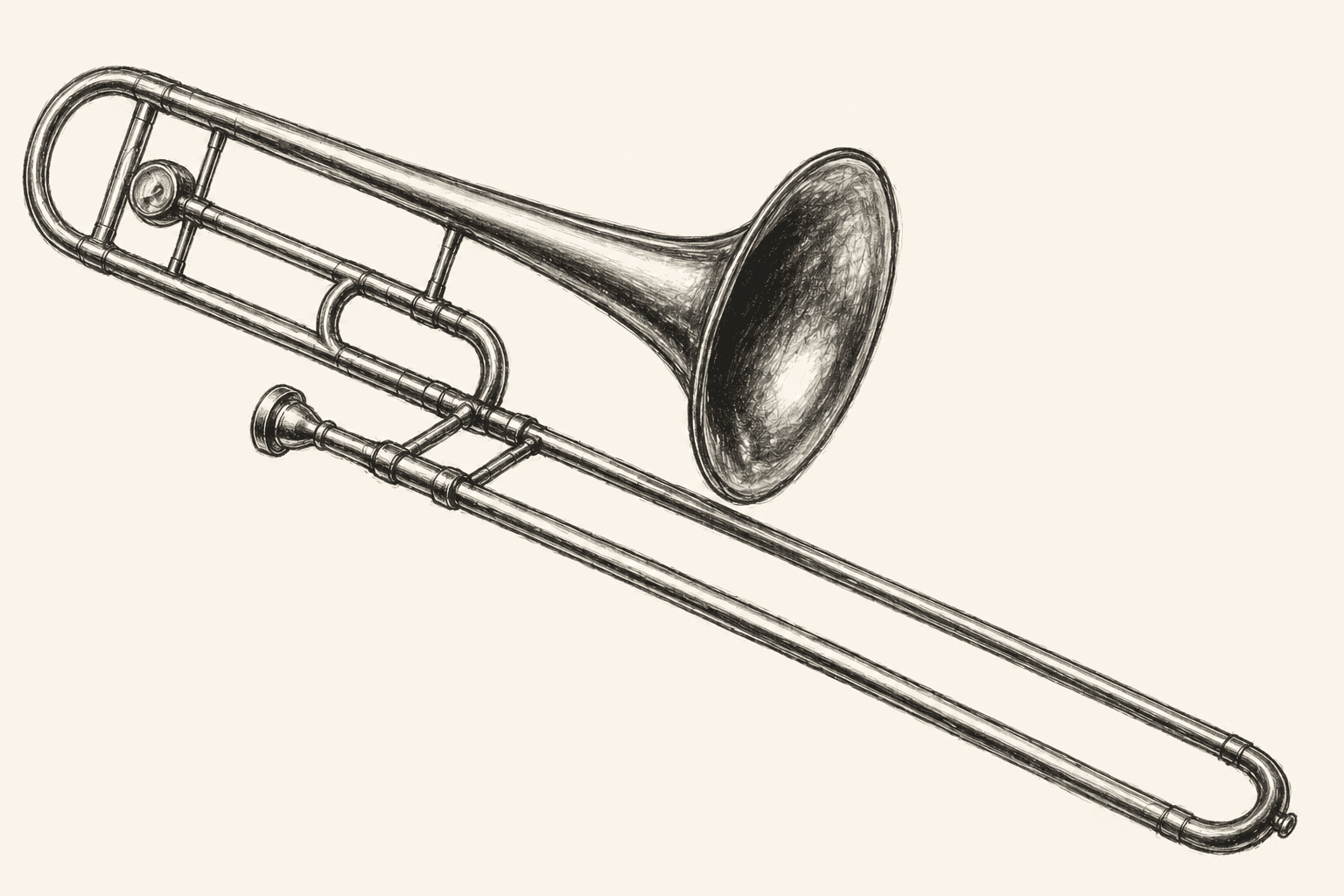
A single brass tube of nine feet, doubled upon itself — its pitch found by a slide of seven positions, its lowest reaches opened by a thumb upon the valve.
The bass trombone is not, as the name might suggest, a simple enlargement of its tenor sibling. It is the same length of tubing in B♭ — but built around a wider bore and a larger bell, fitted with one or two thumb valves, and asked to live a different life: lower, slower, and structurally indispensable. Where the tenor sings, the bass trombone founds.
The instrument speaks across nearly four octaves, from a sepulchral pedal range below the staff to a sustained tenor reach high above it. Its central character, however, lies in the bottom octave — the region the valves were invented to make accessible. There the bass trombone produces some of the most powerful and most patient sound the orchestra commands.
Mechanism
Like the tenor, the bass trombone is a single B♭ tube — slide on the outer arms, bell at the player’s shoulder — pitched by lengthening the air column through one of seven slide positions. What distinguishes it is the bore: typically 0.562″, against the tenor’s 0.547″; and the bell, broader and deeper. The result is a darker, more cavernous fundamental — and a top register noticeably less brilliant than the tenor’s.
Most modern bass trombones carry two thumb valves. The first lowers the instrument to F; the second, engaged with the first, drops it further — most often to G♭ or D. Together they fill the gap between the lowest position of the slide and the pedal B♭, giving the player a complete chromatic compass below the staff. Earlier instruments — the great German F-Bassposaune of the nineteenth century — had only the slide, and their players were, by necessity, athletes.
Voice and Character
The bass trombone’s tone is grave, round, and slow to anger. At soft dynamics it is among the most refined of the low brass — capable of a quiet weight that the tuba, for all its size, cannot quite imitate. At loud dynamics it can cut without becoming brittle, and lend the trombone section a depth that no other instrument supplies.
Above all it is a chordal instrument. The composer who writes a slow chorale for trombones — Mozart in the Requiem, Brahms in the Fourth, Wagner in the Ring, Bruckner everywhere — is writing, whether he says so or not, for the bass trombone’s patience. The whole choir rests on its lowest voice.
“The trombone is, in my opinion, the true head of that family of wind instruments which I have called the epic one.”
— Hector Berlioz, Treatise on Instrumentation
Berlioz spoke of the trombone family entire; the bass trombone is the member he was most often hearing in his head. Treat it accordingly — as the floor on which the brass choir, and often the orchestra, actually stands.
A single brass tube of nine feet, doubled upon itself — its pitch found by a slide of seven positions, its lowest reaches opened by a thumb upon the valve.
The bass trombone rewards the composer who writes for its weight, and punishes the one who writes for its top. A few habits, kept in mind, will spare a great deal of rewriting.
- i.Live in the bottom octave. It is what the instrument was designed for. The lowest register, particularly between F₂ and B♭₁, is where the bass trombone has no rival in the orchestra.
- ii.Treat it as the foot of the chorale. Three trombones in close harmony — two tenors above, the bass beneath — is the inheritance of two centuries. Voice the chord with the bass on the root, and the section will sound at home.
- iii.Allow time for the slide. Slide changes from first to seventh position cover roughly a metre of arm travel; rapid passagework that seems trivial on paper can be impossible in practice. The valves help — but not always.
- iv.Mind the breath. The wider bore demands more air than the tenor. Long sustained tones in the pedal range are perhaps the most expensive notes in the orchestra; build space to draw breath into every line.
- v.Keep clear of the upper extreme. The bass trombone can reach C₅ and beyond, but the tone narrows quickly above F₄. Above this, the tenor will almost always serve the music better.
Beyond these rules, write the line in conversation with the player. A bass trombonist will tell you what is possible — and, with rare generosity, exactly which valve combination will make it so.
The full compass
B♭₁ to C₅ — and chromatically lower with both valves engaged.
The written compass extends from B♭₁ at the foot of the staff to a C₅ at its skilled top — and downward, by way of the two thumb valves, into territory the slide alone cannot reach. Four regions repay study.
Pedale
The pedal range — slow to speak, immense in weight, marked by the unmistakable hollow of the lip vibrating well below its natural register. With the second valve engaged, this region extends chromatically further down still. Approach with the air the notes require.
Basso
The instrument’s home. Round, grave, and capable at any dynamic from a whispered piano to the fullest fortissimo. The valves bridge the slide gap below D₂; everything from here to the staff is the bass trombone speaking with no apology.
Tenore
A region the bass trombone shares with its tenor sibling. Wider in tone, less bright, but evenly produced and sustainable for long phrases. The right register for a slow chorale’s upper voice when the section is full of bass trombones, or for the rare soloistic moment that asks for size rather than brilliance.
Acuto
The upper reach. Narrower and more effortful than the tenor’s top; reserve it for moments of climax, and for players who have made it their study. Above this, the music almost always wants the tenor instead.
A single brass tube of nine feet, doubled upon itself — its pitch found by a slide of seven positions, its lowest reaches opened by a thumb upon the valve.
The bass trombone shares the tenor’s technical inheritance, but the territory in which it works is its own. The wider bore, the larger bell, and the two trigger valves that extend the compass downward change the calculus of every standard device, and the music written for the instrument since the late nineteenth century has, in answer, cultivated its own habits.
Standard techniques
Slide technique on the bass instrument is, if anything, more demanding than on the tenor: the slide is heavier, and the partials are more widely spaced in the lowest octave, so position changes have further to travel and the breath has more work to do. The two triggers — the first lowering the open horn into F, the second (operated either independently or in combination with the first) opening a G♭ or D branch — give the player access to pitches below the slide’s ordinary floor and unlock a family of alternate positions in the middle compass that smooth out the otherwise long traversals.
Single tonguing predominates; legato in the low register, with the triggers and a careful slide, is one of the instrument’s great beauties — the music of Ein Heldenleben, of Mahler’s low chorales, of the slow Bruckner brass writing, depends on it. Double-tonguing is available in skilled hands and is occasionally called for. Mutes — straight, cup, harmon — exist in bass-trombone sizes; the plunger is used at the bell as on the tenor.
Extended techniques
Pedal tones — the fundamental of a given slide position, sounding an octave below the first overtone — are a regular part of bass-trombone writing rather than an extended effect; Wagner, Strauss, and Mahler all asked for them, and the modern instrument speaks them with full body. Multiphonics in the low register are especially resonant: a sung pitch against a played one will set the wide bore ringing in difference and summation tones that no smaller brass can produce.
Flutter-tongue in the bass register is a low growl of considerable menace, and is reliably effective at any dynamic. Glissandi within a partial follow the same rules as on the tenor, with the additional possibility of triggered valve glissandi that cross between the open and F branches. Half-valving the triggers, microtonal slide work, and growl all carry into the bass-trombone vocabulary.
The bass trombone is the foundation of the trombone choir and, in many scores, the gravity of the whole brass section. Its extended palette is broad, but the instrument’s deepest virtue remains the sustained, full-throated low note — patient, resonant, and impossible to mistake for any other voice in the orchestra.
A single brass tube of nine feet, doubled upon itself — its pitch found by a slide of seven positions, its lowest reaches opened by a thumb upon the valve.
A short, partial list — five passages in which the bass trombone is not merely present but indispensable, and in which the orchestra would be a different orchestra without it.
- № 01
Wagner — Götterdämmerung
Siegfried’s Funeral March
Low brass at full stretch — the bass trombone among them, anchoring the chord that mourns a hero.
Listen on Spotify - № 02
Berlioz — Grande messe des morts
Tuba mirum
Four brass choirs answer one another from the corners of the cathedral; the bass trombones are the floor on which it all stands.
Listen on Spotify - № 03
Holst — The Planets
Mars, the Bringer of War
A martial ostinato dragged into the lowest register — the bass trombone giving the music its threat.
Listen on Spotify - № 04
Mahler — Symphony No. 6
Finale
Among the great low-brass chorales of the literature; the bass trombone speaks where the tenor cannot reach.
Listen on Spotify - № 05
Stravinsky — Le Sacre du printemps
Sacrificial Dance
Stabbed pedal tones, brutal and exact — the instrument in its rawest civic role.
Listen on Spotify
Further entries will be added as our study deepens.
A single brass tube of nine feet, doubled upon itself — its pitch found by a slide of seven positions, its lowest reaches opened by a thumb upon the valve.
The trombone is the oldest of the orchestra’s brass — older even than the modern violin. Its Renaissance ancestor, the sackbut, was already a fully chromatic instrument in the fifteenth century, used in the basilicas of Venice and the courts of Burgundy. From the sixteenth century the family was built in matched sizes — soprano, alto, tenor, bass — and the lowest member, in F or E♭, was the bass trombone’s first form.
The classical bass trombone
Through the eighteenth century the bass trombone remained chiefly an instrument of the church. Mozart wrote for it in the Requiem; Beethoven gave it its first symphonic role in the Fifth, and again — unforgettably — in the Ninth. The instruments of this era were narrower of bore than today’s, often pitched in F, and frequently played by specialists drawn from a small confraternity of cathedral musicians.
The German F-Bassposaune
Through the nineteenth century the German F-Bassposaune reigned in the orchestral pit — a long instrument, slow of slide, whose lowest positions required a handle attached to the brace for the player’s outstretched arm. Wagner wrote for it in the Ring; Brahms, Bruckner, and Mahler followed. Its tone was darker and weightier than the modern instrument; its execution was slower and far more athletic.
Sattler and the modern instrument
Around 1839, the Leipzig maker Christian Friedrich Sattler fitted a B♭ tenor trombone with a thumb-operated rotary valve in F — producing, in effect, a tenor-bass capable of reaching the lower register without the long F slide. The design spread; through the late nineteenth and early twentieth centuries it gradually displaced the older F instrument, particularly in the larger American orchestras.
The two-valve bass
The mid-twentieth century saw the addition of a second thumb valve — in G♭, D, or E♭ — engaged together with the F valve to fill the gap between the lowest slide position and the pedal B♭. The double-valved bass trombone, with its wide bore, large bell, and complete chromatic compass below the staff, is the instrument heard today in nearly every professional orchestra. It is, in essence, the instrument Stravinsky already imagined when he wrote the lowest sustained pages of Le Sacre.
Specifications
A summary, for the composer’s desk.
- Family
- Brass, lip-reed
- Italian
- Trombone basso
- German
- Bassposaune
- French
- Trombone basse
- Range
- B♭₁ — F₅ (with valves, chromatic to C₁ and below)
- Transposition
- Non-transposing; bass clef, occasionally tenor clef
- Bore
- Approx. 14.3 mm (0.562″) — wider than the tenor
- Bell
- Approx. 24–27 cm (9½–10½″), of yellow or gold brass
- Valves
- Two thumb valves — typically in F and G♭ (or D)
- Mouthpiece
- Deep funnel cup, of brass or silver-plate
- Origin
- Germany, mid-19th century; descended from the Renaissance sackbut