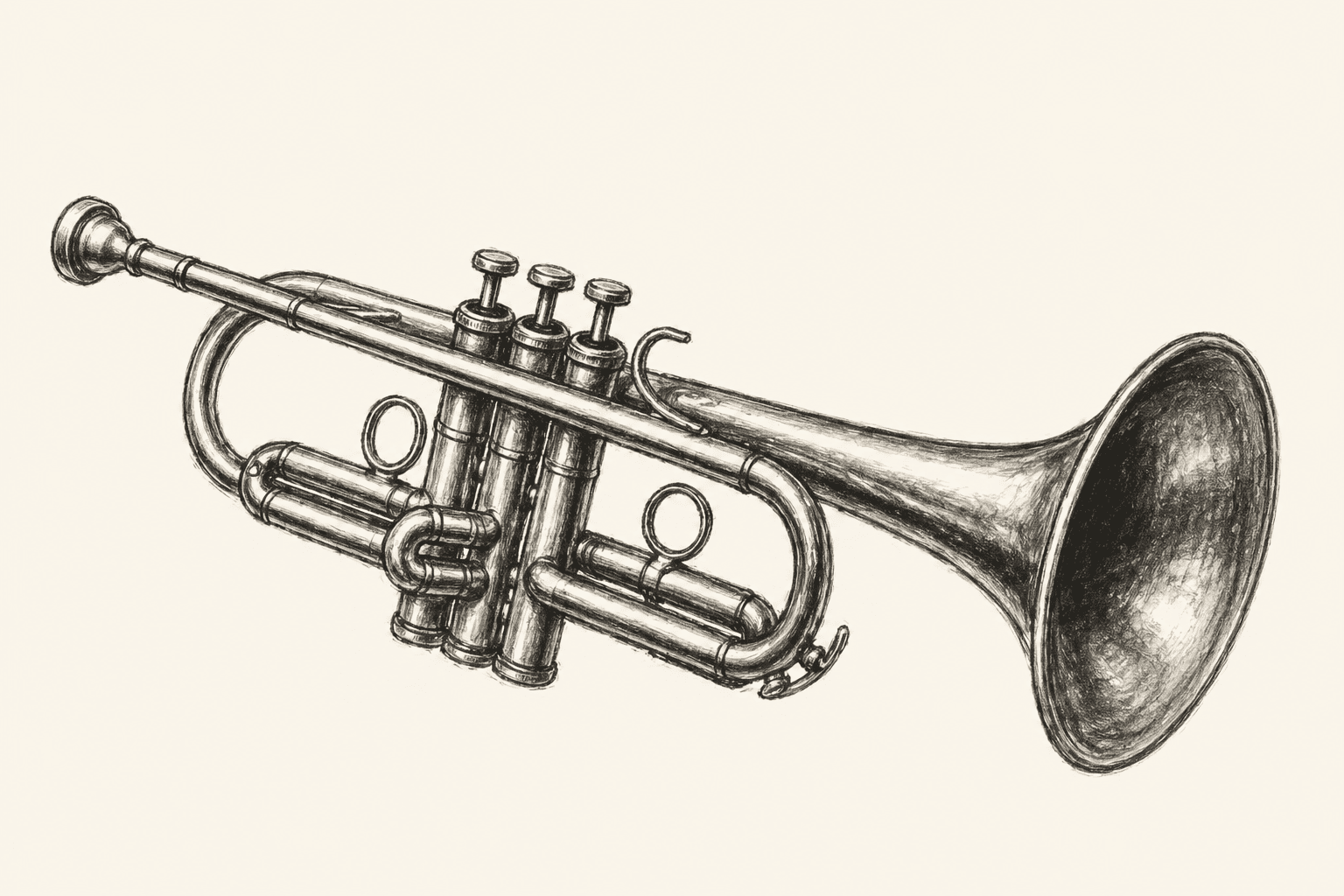
The instrument is, in essence, a cylindrical tube of some nine feet — folded once, and tuned by the slow extension of the arm.
Of all the brass, the trombone is the most patient. Its bore is largely cylindrical, where the trumpet and horn taper; its tuning is left to the player’s arm and ear, where the others trust valves; and its sound — produced by a deep cup mouthpiece against a long unbroken column of air — is in turn solemn, oratorical, sometimes grotesque, depending entirely on the temperament of the writer who summons it.
It is an instrument that rewards space. Its lowest octave wants air and time; its highest is bright and effortful, and asks of the player a careful embouchure. Between the two lies the singing tenor — the register of Mozart’s Tuba mirum, of Mahler’s great solo in the Third, of every chorale Wagner ever wrote it. To know the trombone is to know these three rooms and the doors between them.
Mechanism
The trombone is built of two principal sections — the bell and the slide — joined at a right angle and braced with stays. Air enters through a deep cup mouthpiece, travels the length of the slide, doubles back through the tuning slide and bell, and emerges from a flared bell of brass. The slide itself is two precisely fitted inner and outer tubes, and its seven positions stand in for the seven chromatic steps the harmonic series cannot reach by lip alone.
Most modern tenor instruments carry a thumb valve that drops the fundamental from B♭ to F, extending the chromatic compass downward and easing certain awkward passages into reach. The differences with and without are real, but for the composer they are mostly invisible. Write well for the plain horn and you write well for the F-attachment too.
Voice and Character
Berlioz, who knew the orchestra as well as any composer ever has, thought the trombone the true head of an “epic” family — possessing, he wrote, both nobility and grandeur in the highest degree, and capable of every dignified accent from religious meditation to wild battle clamour. He meant this with unguarded affection. The trombone does not chatter. It pronounces.
The instrument has, by long accident, also become the orchestra’s sacred voice. Its first centuries were spent in the Church and in the funeral procession — three trombones in chorale, doubling the lower voices of the choir — and the chorale-style writing of Mozart and Wagner still draws on that memory. Honour that history. The trombone will sound liturgical even when you wish it would not.
“The trombone, in my opinion, is the true head of that family of wind instruments which I have called epic.”
— Hector Berlioz, Treatise on Instrumentation
The trombone will outlast every fashion that has yet been imposed on it. Write for it without irony, or with all of it; either way, the instrument will know what to do.
The instrument is, in essence, a cylindrical tube of some nine feet — folded once, and tuned by the slow extension of the arm.
The trombone is forgiving of the patient composer and unsparing of the hurried one. A handful of habits, kept in mind, will save many later revisions.
- i.Mind the slide. The arm is faster than it looks but slower than valves; rapid stepwise lines that cross the full slide will smear unless the tempo allows.
- ii.Write them in chorale. Three trombones in close harmony, marked piano, will summon four hundred years of liturgy whether you wished them to or not.
- iii.Use the glissando knowingly. A true glissando crosses one slide-position only — never across a partial. Ravel’s Boléro is the lesson in miniature.
- iv.Choose the right clef. Bass clef as a rule; tenor clef when it spares the reader a thicket of ledger lines; alto only for the alto trombone.
- v.Mind the breath. A trombone line without a place to breathe is no line at all. The bore is long, the air consumed quickly; build the rests into the phrase, not around it.
Beyond these few rules, write with the player in mind. A trombonist will tell you what is possible — and, more usefully, what is beautiful.
The full compass
E₂ to F₅ — three octaves and a step, with pedal extension below.
The compass extends from the low E₂ — at the foot of seventh position — to a high F₅ in skilled hands, and beyond on rare occasion. Below E₂ lie the pedal tones: the fundamentals of each slide position, used sparingly but unforgettably. Three regions repay study, with the pedal a fourth.
Pedale
The fundamental tones of each slide position — slow to speak, vast in resonance. Used by Berlioz, Wagner, and Strauss for moments of subterranean colour. Never to be expected of a player who has not been warned.
Basso
Dark, weighty, slow to speak in the lowest reaches. Magnificent for sustained lines and for the lowest voice of a brass chorale; treacherous in rapid passagework.
Tenore
The singing voice of the instrument. Here the trombone most resembles a baritone, and here most great solos live. Direct, vocal, faintly grainy — supremely expressive at any dynamic.
Acuto
Bright, declamatory, increasingly effortful. The territory of the principal player and the heroic line; reserve it for moments the music has earned.
The instrument is, in essence, a cylindrical tube of some nine feet — folded once, and tuned by the slow extension of the arm.
Alone among the brass, the trombone changes pitch by lengthening its own tube. The slide is at once the source of the instrument’s expressive freedom and the limit of its agility — and a great part of what one calls trombone technique consists in the daily reconciliation of those two facts.
Standard techniques
Slide legato is the trombone’s peculiar problem. A connected slur across a slide change risks an audible smear; the player therefore relies on light natural slurs between adjacent partials, on carefully chosen alternate positions that avoid awkward traversals, and — for very rapid legato — on doodle-tonguing, a soft du-dle articulation that disguises the tongue without breaking the line. Single tonguing serves most music; double and triple tonguing are used, but more sparingly than on trumpet, and the instrument prefers a broader articulation to suit its grain.
The great glissando within a single partial — a smooth, vocal traverse from one position to another — is the gesture no other orchestral instrument can imitate. Its limit is the partial itself: composers must keep glissandi within an interval the slide can cover without crossing into a different harmonic. The mute family is smaller than the trumpet’s but no less expressive: straight, cup, and harmon are standard; plunger and various practice mutes appear as the music asks.
Extended techniques
The trombone is, of all the brass, the most resonant medium for multiphonics: the bore is wide, the bell flares generously, and the player’s sung pitch carries through the column with a startling fullness. Berio, Xenakis, and a long line of composers since the 1960s have written for the device; the effect, properly balanced, can produce stable three- and four-note chords from a single instrument. Flutter-tongue is rich and granular, particularly in the lower compass; the growl, achieved by humming through the embouchure, gives a rough vocal edge familiar from jazz writing.
On instruments with an F-attachment, half-valving the trigger produces a smeared microtonal colour; microtones by slide position are unproblematic and exact. Lip trills between adjacent partials, doits, falls, and smears belong to the ordinary professional vocabulary, and the plunger, manipulated by the left hand over the bell, opens and closes a long vowel that has long since left the dance band for the symphony.
The slide is the trombone’s gift and its discipline. Most of what is idiomatic on the instrument follows from a clear understanding of what the slide will and will not do, and the composer who keeps that fact in view will find the trombone among the most generous of the brass.
The instrument is, in essence, a cylindrical tube of some nine feet — folded once, and tuned by the slow extension of the arm.
A short, partial list — five places to begin if one wishes to know what the trombone can do, and what it has been asked to do by composers who loved it.
- № 01
Mozart — Requiem, K. 626
Tuba mirum
A solo for tenor trombone summoning the dead — austere, declamatory, terrifyingly slow.
Listen on Spotify - № 02
Mahler — Symphony No. 3
First movement, principal trombone solo
A long recitative, bare and noble, that seems to speak for the awakening summer itself.
Listen on Spotify - № 03
Ravel — Boléro
Trombone solo with glissando
Sleazy, brilliant, half-vaudeville — the most famous trombone glissando ever written.
Listen on Spotify - № 04
Wagner — Die Walküre
Ride of the Valkyries
The trombones in their epic role: noble, granite, untranslatable into any other voice.
Listen on Spotify - № 05
Rimsky-Korsakov — Russian Easter Festival Overture
Trombone recitative
A liturgical chant, intoned alone above the orchestra — the trombone as cantor.
Listen on Spotify
Further entries will be added as our study deepens.
The instrument is, in essence, a cylindrical tube of some nine feet — folded once, and tuned by the slow extension of the arm.
The trombone traces its descent to the sackbut — a slim, soft-toned slide instrument that, in the courts of Burgundy and Flanders in the fifteenth century, gave the late-medieval wind band a chromatic bass. Already in 1495 the English king’s household kept sackbut players on retainer; by the early sixteenth century the instrument was settled in cathedrals across Europe, doubling the lower voices of the choir.
The Baroque and the Church
For two hundred years the trombone was, more than anything else, a sacred instrument. Gabrieli wrote vast antiphonal canzonas for it in San Marco; Schütz and Bach used it in the Passions; the German Lutheran Stadtpfeifer tradition kept three trombones in chorale alongside the cornetts. Outside the church it was rarely heard. Its tone was darker, narrower, and more vocal than what we know today.
Mozart and the modern orchestra
Mozart’s Tuba mirum in the Requiem is the moment at which the orchestral trombone was first asked to sing as a soloist — and consented. By the end of the eighteenth century the trombones had entered the symphony orchestra in earnest, first through opera and sacred music, then through Beethoven’s Fifth, where three of them announce the finale. From that point onward they were never asked to leave.
Wagner, Mahler, and the great expansion
The nineteenth century enlarged the trombone in every direction. The bore widened; the bell flared; the bass trombone was added below; the tenor took on its first thumb valves. Wagner wrote for the section as a single great voice, and Mahler entrusted to it some of the longest and most exposed solos in the literature. By the close of the century the trombone was no longer a guest at the orchestra. It was a founding member of it.
The modern instrument
The modern tenor trombone is, in essence, the design that German and American makers had codified by the early twentieth century — a wider bore than the Baroque sackbut, a flared bell, and, on most instruments, a thumb valve dropping the fundamental from B♭ to F. Subsequent decades have refined the materials and the valve mechanism, but the instrument a player picks up today is recognisably the one Mahler wrote for in his Third, the one Ravel orchestrated in Boléro, the one Strauss treated with such love. It is, by the standards of orchestral instruments, a quietly settled craft.
Specifications
A summary, for the composer’s desk.
- Family
- Brass, slide
- Italian
- Trombone
- German
- Posaune
- French
- Trombone
- Range
- E₂ — F₅ (pedals to B♭₁ and below)
- Transposition
- Non-transposing; bass & tenor clefs
- Length unfolded
- Approx. 2.74 m (9′) of cylindrical tube
- Bore
- 12.5–13.9 mm — predominantly cylindrical
- Bell
- 190–215 mm (7½–8½″) in diameter
- Origin
- Burgundy and Flanders, 15th century