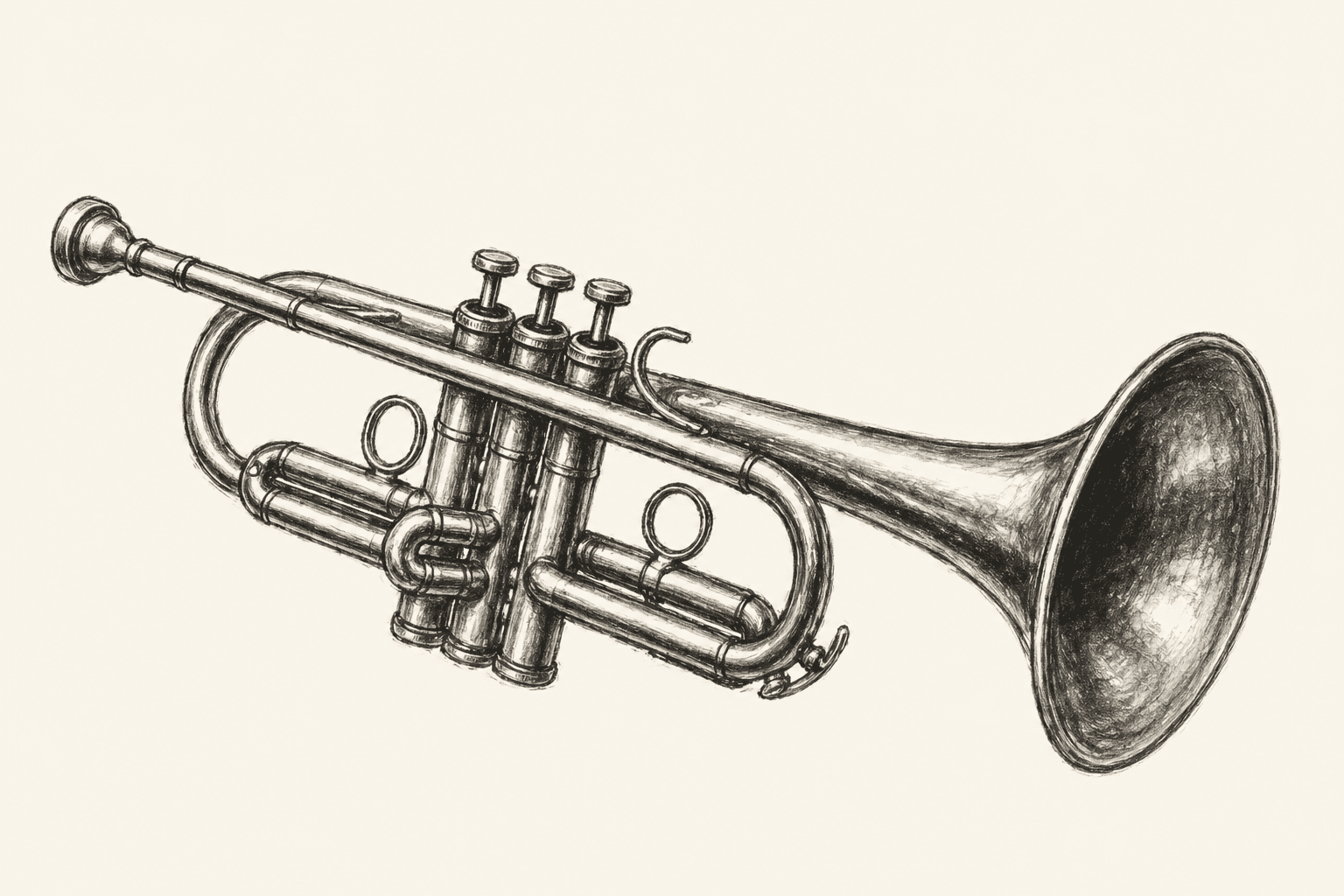
A length of brass folded twice upon itself — three valves, a cup mouthpiece, and the player’s breath shaped by the lips.
The trumpet is the orchestra’s herald. Older than the orchestra itself — older, indeed, than most of what we now call music — its voice has announced kings, called the hours, summoned the faithful, and led men into battle. When at last it took its place among the strings and woodwinds, it brought all of that history with it, and lost none of it in the journey.
The instrument is small and bright. Its tube, almost wholly cylindrical, flares only at the last — the bell — and that small flare is the whole secret of its tone: penetrating, focused, capable of carrying over a full orchestra without effort. Add a mute and the same instrument becomes confidential, even haunted. Few instruments span so wide an emotional compass on so narrow a piece of brass.
Mechanism
The modern trumpet is some four feet ten inches of tubing folded twice upon itself, fitted with three piston valves. Each valve, when depressed, opens an additional length of tubing — the second a semitone, the first a tone, the third a tone and a half — and the seven possible combinations supply the chromatic notes between the natural harmonics of the fundamental tube. The lips, set against a shallow cup mouthpiece, choose among those harmonics; the valves do the rest.
Most orchestral trumpets are pitched in B♭ or in C. The B♭ is the more common in bands and in the player’s daily life; the C, slightly shorter, is preferred by many orchestral players for the directness of its speech. Either may be written for; what matters is that the composer specifies, and that the part be transposed accordingly.
Voice and Character
Berlioz, characteristically, gave the trumpet its due: “its tone is noble and brilliant, suited to warlike ideas, to cries of fury and of vengeance, as to songs of triumph.” He wrote that of an instrument with no valves — a trumpet capable of only its natural harmonics. The valved trumpet that succeeded it has gained a chromatic vocabulary without surrendering any of that older nobility.
Mute it and the instrument enters another world altogether — nasal, ironic, distant, sometimes plaintive. The straight mute sharpens its edge; the cup mute softens it; the harmon mute, with or without its stem, gives the brittle, jazz-inflected voice that has so coloured the twentieth century. Each is a different instrument, in effect. Each is worth knowing by ear.
“The trumpet shall sound, and the dead shall be raised incorruptible.”
— 1 Corinthians 15:52
No other orchestral instrument carries quite this weight of inherited meaning. Use it knowing that — and let the listener’s memory work for you.
A length of brass folded twice upon itself — three valves, a cup mouthpiece, and the player’s breath shaped by the lips.
The trumpet is direct, athletic, and tireless within reason. A few habits will keep the writing both idiomatic and humane.
- i.Respect the lip. Long stretches in the high register tire even the strongest player. Build the part so that the most demanding passages have rest before and after.
- ii.Choose a key. Specify B♭ or C at the top of the part. The choice affects the player’s instrument, and changing midstream is a real and audible event.
- iii.Mute deliberately. Mark the mute by name — straight, cup, harmon — and give the player at least a few bars to fit it. Each transforms the instrument entirely.
- iv.Let it sing as well as call. The middle register, marked dolce or espressivo, sings as warmly as any voice in the orchestra. The trumpet is not only for fanfares.
- v.Remember the harmonic series. Open fifths, fourths, and the bugle-call major triad sit naturally under the fingers and in the air. Old material; still alive.
Beyond these, a trumpeter will gladly tell you what speaks well and what costs blood. Ask, and listen. The answer is rarely what the score first suggests.
The full compass
F♯₃ to D₆ as written — close to three octaves, with specialists reaching higher.
The written compass extends from a low F♯₃ — the bottom of the instrument’s practical range — to a written D₆ and, on a piccolo trumpet, considerably above. On the B♭ instrument every written pitch sounds a major second lower. Three regions repay study; a fourth waits for the player who lives in it.
Grave
The pedal end of the instrument — broad, slightly hollow, a touch husky. Slow to centre and best approached with care; magnificent for held notes beneath the orchestra, less reliable for rapid passagework.
Medio
The singing core of the instrument. Direct, focused, and infinitely flexible from pianissimo to fortissimo. Most great solos live here — Mahler, Copland, the second movement of Shostakovich Five.
Acuto
Bright, penetrating, athletic. The territory of fanfares and climaxes; brilliant when fresh, costly when prolonged. Use with awareness of what has been asked of the player in the bars before.
Sopracuto
The clarino register, kept alive by Bach and resurrected by the piccolo trumpet. Reserve it for specialists and for moments the music has earned. Above all, give the player room to breathe.
A length of brass folded twice upon itself — three valves, a cup mouthpiece, and the player’s breath shaped by the lips.
The trumpet is, by long custom, the most articulate of the brass — and it has needed to be. Heralding, signalling, declaring, lamenting: every rhetorical task the orchestra has asked of brass has, at one time or another, been laid at the trumpet’s door. The vocabulary that has accumulated in answer is correspondingly large.
Standard techniques
Tonguing is the trumpet’s native virtue. Single tonguing is supreme; double tonguing (ta-ka) and triple tonguing (ta-ta-ka or ta-ka-ta) are part of the ordinary professional equipment, and the rapid repeated articulation that issues from a good section is among the orchestra’s most exhilarating sounds. Lip slurs across the harmonic series — the trumpet’s harmonics being closer together than the horn’s only in the high register — provide its legato; full slurred legato over wide intervals is also idiomatic, and the dynamic compass runs from a feathery pianissimo to a blazing fortissimo the orchestra cannot easily cover.
The mute family is the largest of any orchestral instrument. The straight mute, of metal or fibre, sharpens the tone toward steel; the cup mute rounds it back into a soft, withdrawn cushion; the harmon (with or without its stem) gives the buzzing, dry voice that twentieth-century music has loved most; the plunger, manipulated by hand, opens and closes a long vowel on the bell; the bucket, the wah-wah, and various practice and felt mutes complete the kit. Most of these come from the jazz tradition; all of them now belong to the symphonic palette.
Extended techniques
Flutter-tongue on the trumpet is bright, granular, and carries — Strauss, Mahler, and Stravinsky all asked for it. The growl, produced by humming through the embouchure, gives a rough, vocal edge familiar from the jazz tradition. Half-valving — pressing the valves only partway — produces a smeared, microtonal tone of considerable colour; full glissandi, the shake (a rapid lip trill on a single pitch), the doit (a quick rise off the note), the fall (its converse), and the smear (an entrance bent up to pitch from below) all live easily in the modern part.
Multiphonics — the player singing one pitch while sounding another — are obtainable, though less resonant than on the larger brass; they belong chiefly to the contemporary repertoire. Valve tremolo, the rapid alternation between two fingerings of a single pitch, gives a faint, beating tremor. Circular breathing, by no means standard but increasingly common among orchestral principals, permits long phrases without audible relief.
Across all of this, the trumpet remains a creature of clear speech. The extended palette extends what the instrument is, but it does not replace it; the cleanly tongued, brilliantly tuned, perfectly aimed note is, and will remain, the trumpet’s first and finest device.
A length of brass folded twice upon itself — three valves, a cup mouthpiece, and the player’s breath shaped by the lips.
A short, partial list — five places to begin if one wishes to know what the trumpet can do, and what it has been asked to do by composers who understood it.
- № 01
Mahler — Symphony No. 5
Opening fanfare
A solo trumpet, alone, in the funeral march’s opening — military, exact, and already grieving.
Listen on Spotify - № 02
Bach — Brandenburg Concerto No. 2
First movement
The clarino at full stretch — a high natural trumpet that for two centuries no living player could meet.
Listen on Spotify - № 03
Mussorgsky / Ravel — Pictures at an Exhibition
Promenade
The instrument as walker — measured, public, slightly grave — leading the listener from canvas to canvas.
Listen on Spotify - № 04
Stravinsky — Petrushka
Ballerina’s Dance
A cornet solo, brittle and tin-soldier bright, danced over a snare-drum tattoo.
Listen on Spotify - № 05
Copland — Quiet City
Solo trumpet
A muted line over English horn and strings — the sound of a deserted street, late at night.
Listen on Spotify
Further entries will be added as our study deepens.
A length of brass folded twice upon itself — three valves, a cup mouthpiece, and the player’s breath shaped by the lips.
The trumpet is, with the drum and the flute, among the very oldest of instruments. Bronze and silver examples were buried with Tutankhamun; the Romans had their tuba and buccina; medieval Europe its long ceremonial straight trumpet. For most of this long history the instrument was, by our standards, a bugle — capable only of the natural harmonics of its single fundamental tube.
The Baroque clarino
By the late seventeenth century a tradition of clarino playing had grown up around the highest harmonics of the natural trumpet — the only region in which adjacent notes were close enough to form a melody. Bach wrote for it as if it were as fluent as any woodwind: the second Brandenburg, the Magnificat, the Christmas Oratorio. When the tradition died, in the late eighteenth century, those parts became unplayable for nearly two hundred years.
Stölzel and Blühmel
The valve, which would change everything, was patented in Berlin in 1818 by Heinrich Stölzel and Friedrich Blühmel — though both had been working on it for some years before. Their early box valves gave way to rotary valves in central Europe and, in France and the English-speaking world, to the piston valves designed by François Périnet. By mid-century the chromatic trumpet was a settled fact, and the older crooks and natural instruments had begun their long retreat into the museum.
Cornet and trumpet
For much of the nineteenth century the cornet — a more conical, more agile cousin — was preferred for solo and lyrical work, and the natural trumpet kept its place for fanfares and tuttis. French scores through Berlioz and well into Bizet specify the two side by side. Only in the twentieth century did the modern valved trumpet absorb most of the cornet’s repertoire and most of its players.
The modern instrument
The trumpet a player picks up today — most often in B♭ or in C, with three Périnet valves and a slightly tapered bore — is essentially the instrument of a century ago. The piccolo trumpet, an addition of the twentieth century, has restored Bach’s clarino parts to playable circulation. Beyond that, the design has settled. What changes now is the player.
Specifications
A summary, for the composer’s desk.
- Family
- Brass, lip-reed
- Italian
- Tromba
- German
- Trompete
- French
- Trompette
- Range
- Written F♯₃ — D₆ (sounding a major second lower on B♭ instrument)
- Transposition
- Most often in B♭; in C for many orchestral works; treble clef
- Tube length
- Approx. 1.48 m (4′ 10″) for the B♭ instrument
- Bore
- Predominantly cylindrical, flaring to the bell
- Mouthpiece
- Shallow cup, of brass or silver-plate
- Origin
- Antiquity; the modern valved instrument, Germany c. 1814